
Are you considering upgrading your laundry room with the latest Wi-Fi-enabled tech? Before you buy, you must understand the disadvantages of smart washing machine models. While controlling laundry from your phone sounds amazing, the reality often involves hidden costs, frustrating software glitches, and expensive repairs.
For many homeowners, the promise of an automated home quickly fades when faced with these unexpected smart appliance drawbacks. This guide breaks down everything the salespeople won’t tell you.
We will explore the financial, technical, and practical downsides of connected laundry appliances. By the end of this guide, you will know exactly if this technology fits your household or if a traditional machine is better.
Table of Contents
What Actually Makes a Washing Machine “Smart”?
Before diving into the negatives, we must define what makes these machines different. It helps to understand how they compare to the traditional types of washing machine on the market.
Unlike standard appliances, a smart washer relies on three core tech features:
- Wi-Fi Connectivity: Connects directly to your home network, allowing you to monitor, start, or pause your appliance remotely via a smartphone.
- Companion Smartphone Apps: Uses proprietary applications like LG ThinQ or Samsung SmartThings to send push alerts when cycles finish or to download custom wash settings.
- AI Fabric Sensing: Built-in advanced sensors automatically detect the weight and fabric softness of your laundry load to adjust water levels and detergent dosing.
While these features sound incredibly convenient on paper, they introduce complex electronics into a wet, vibrating environment. This combination is precisely where the most common connected washer issues begin to surface.
10 Core Disadvantages of Smart Washing Machine Technology
The shift from mechanical dials to digital touchscreens has transformed home appliances. However, this evolution brings several significant downsides that buyers often overlook.
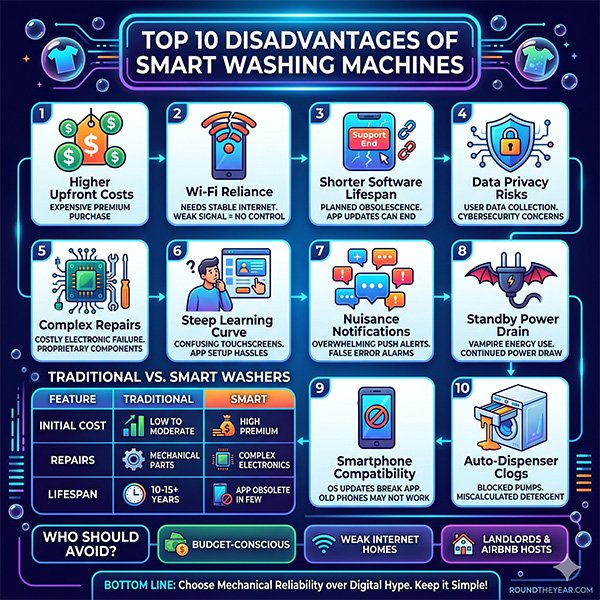
1. Higher Upfront Costs and Premium Pricing
The most immediate hurdle is the retail price. Smart washing machines cost significantly more than their traditional counterparts. You are paying a premium for the Wi-Fi modules, touchscreen interfaces, and sensor arrays.
On average, expect to pay $200 to $500 more for a connected model. This higher initial investment rarely translates into better core washing performance. If you are on a strict budget, exploring cheap washing machines under $100 might be a wiser financial move than overpaying for digital convenience.
2. Over-Reliance on Wi-Fi and App Connectivity
Smart features are entirely dependent on a stable internet connection. If your home network goes down, you instantly lose access to remote controls and notifications. This can be highly frustrating during an internet outage.
Furthermore, laundry rooms are often located in basements or utility closets. These areas typically have the weakest Wi-Fi signals in a house. A weak connection leads to delayed alerts and unresponsive app controls.
3. Shorter Software Lifespans and Forced Obsolescence
Mechanical washers can last 10 to 15 years with basic maintenance. Smart washers, however, are bound by software lifespans. Manufacturers eventually stop updating the companion apps for older models.
When app support ends, your expensive smart washer becomes a standard, “dumb” machine. These app-controlled laundry problems mean your appliance’s smart features might only last a few years before becoming entirely obsolete.
4. Data Privacy and Cybersecurity Risks
Connected appliances gather data about your household habits. They track when you wash, how often you wash, and what cycles you use. Manufacturers often share or sell this anonymized data to third parties.
Additionally, any device connected to your Wi-Fi network poses a slight cybersecurity risk. While rare, hackers can exploit vulnerabilities in smart home appliances to gain access to your wider home network.
5. Expensive and Complex Repairs
When a traditional washer breaks, a local technician can usually swap out a mechanical part affordably. Smart washers are different. They rely on complex, proprietary motherboards and digital control panels.
If a digital board fries, it often costs hundreds of dollars to replace. Furthermore, standard repair technicians may not have the software diagnostic tools required. You are often forced to hire expensive, brand-authorized repair services.
[Image prompt: A photorealistic close-up of a repair technician’s hands inspecting a complex green circuit board inside a modern washing machine. The lighting is focused on the microchips and wiring. Professional repair setting, highly detailed.]
6. The Steep Learning Curve
Traditional machines are intuitive: turn a dial and press start. Smart washing machines often require navigating deep menus on digital touchscreens. This can be a massive barrier for elderly users or houseguests.
Setting up the initial Wi-Fi connection and linking the companion app can also be tedious. If the app glitches or logs you out, starting a simple load of laundry becomes an irritating tech-support chore.
7. Nuisance Notifications and False Alarms
Hyper-sensitive AI sensors are meant to protect your clothes. However, they frequently cause false alarms. A slightly unbalanced load might trigger a sensor that pauses the entire cycle indefinitely.
Push notifications can also become overwhelming. Receiving an alert on your phone every time a minor error occurs—or constantly being prompted to buy more detergent—can make laundry feel more stressful.
8. Standby Power Drain and Energy Waste
Smart appliances are never truly turned off. They remain in standby mode, constantly scanning for Wi-Fi signals and waiting for remote app commands.
This continuous connectivity creates vampire power drain. While a traditional washing machine uses zero electricity when powered down, a connected model continuously draws a small amount of current, slightly increasing your monthly utility bills over time.
9. Smartphone Compatibility and App Glitches
To utilize remote features, your smartphone must meet the manufacturer’s minimum operating system requirements. If you use an older mobile device, you might not be able to install the companion app at all.
Furthermore, routine smartphone OS updates can temporarily break the appliance app. This leaves you locked out of custom wash cycles or monitoring features until the manufacturer releases a compatible software patch.
10. Auto-Dispenser Clogs and Miscalculations
Many premium models feature bulk detergent auto-dispensers driven by sensors. While designed for convenience, these mechanical pumps frequently clog if you switch detergent brands or use highly concentrated, thicker soap formulas.
The smart sensors can also miscalculate the required soap volume. This leads to oversudsing, which leaves a sticky residue on your clothes and can eventually damage the machine’s internal drainage pump.
Traditional vs Smart Washers: A Clear Comparison
To make an informed decision, you must weigh the pros and cons directly. Analyzing traditional vs smart washers side-by-side reveals where your money is actually going.
Feature | Smart Washing Machine | Traditional Washing Machine |
Initial Purchase Cost | High premium pricing | Low to moderate pricing |
Repair Complexity | High (Requires digital diagnostics) | Low (Standard mechanical parts) |
Control Interface | App-based menus and touchscreens | Physical mechanical dials and buttons |
Expected Lifespan | Software may become obsolete quickly | Mechanical parts last 10-15 years |
Privacy Risk | Yes (Collects user data via Wi-Fi) | None (No network connection) |
As the table shows, traditional machines excel in long-term reliability. Smart machines trade that reliability for short-term digital convenience.
Who Should Avoid Buying a Smart Washing Machine?
Smart appliances are not universally beneficial. Certain households will find the technology more burdensome than helpful. If you fall into one of the following categories, you should likely stick to standard models:
- Budget-Conscious Buyers: The high upfront cost and expensive repair bills negate any minor savings in water or energy efficiency. You will spend more over the lifetime of the machine.
- Homes with Unstable Internet: If your laundry room is in a Wi-Fi dead zone, you will pay for features you cannot even use. The constant disconnects will only cause frustration.
- Landlords and Airbnb Hosts: Guests and tenants need appliances that are instantly intuitive. Forcing someone to download an app just to wash their clothes is a terrible user experience. If you need a reliable, compact, and completely mechanical alternative for a rental unit, read our in-depth Panda PAN56MGP3 washing machine review.
FAQ
While the mechanical motors are similar, the digital components fail more frequently. Touchscreens, Wi-Fi modules, and motherboards are highly sensitive to moisture and vibration, leading to a higher rate of electronic failures.
Yes, most smart washers have basic physical controls that function without the internet. However, by keeping it offline, you are wasting the premium price you paid for its smart capabilities.
Yes. Replacing a proprietary digital control board can easily cost $300 to $500, not including specialized labor. Traditional machines use cheaper, universal mechanical parts that are much easier to source and install.
Generally, yes, but it carries a small risk. You must ensure your home Wi-Fi network is secured with a strong password. You should also regularly update the washing machine’s firmware to patch any security vulnerabilities.
Bottom Line
While the allure of starting a load of laundry from your office is undeniable, the reality often falls short of the marketing hype. The disadvantages of smart washing machine models—from steep upfront costs to inevitable software glitches—are impossible to ignore.
If you value mechanical reliability, straightforward repairs, and long-term durability, sticking to a high-quality traditional washer is your safest bet. You avoid the headache of forced obsolescence and network troubleshooting entirely.
Weigh your household’s actual needs against the tech hype. Choose the machine that makes your daily routine genuinely easier, not more complicated. Sometimes, the smartest choice for your home is keeping things delightfully simple.




Leave a Reply