
Is your laundry routine taking too much time, or are your clothes not coming out as clean as they should? Understanding the different types of washing machine is the first step to solving these everyday household frustrations. Choosing the right appliance makes a massive difference in your daily life.
Replacing an old appliance is a big financial decision. You want a machine that cleans thoroughly while saving water and electricity. If you are still weighing whether you need to upgrade from manual hand-washing or laundromat visits, it helps to first understand the overall advantages and disadvantages of washing machine ownership. With so many models available today, walking into an appliance store or browsing online can feel incredibly overwhelming for any buyer.
We have researched and broken down every major category available on the market today. This comprehensive guide will help you navigate agitators, impellers, and tumbling systems. By the end of this article, you will know exactly which appliance fits your space, budget, and fabric care needs.
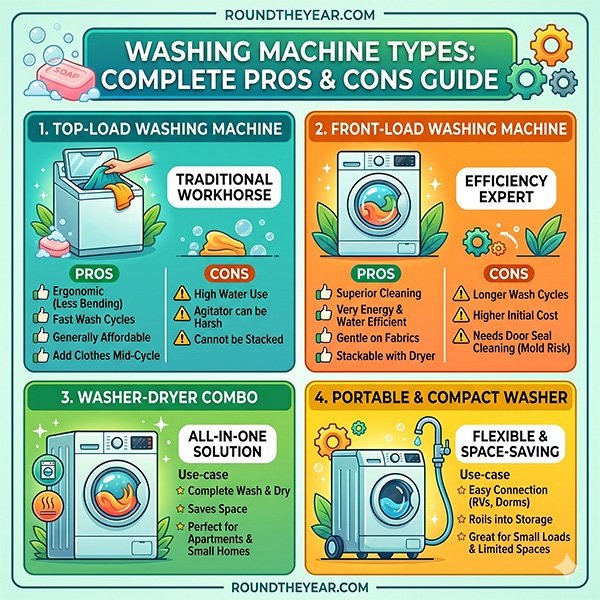
Table of Contents
Different Types of Washing Machine on the Market
The appliance aisle is packed with innovative designs engineered for specific household needs. You cannot simply buy the cheapest option and expect stellar results. You must match the machine’s mechanical action to your family’s laundry habits to ensure long-term satisfaction.
Some machines are built for heavy-duty soil removal, while others prioritize delicate fabric care and energy conservation. Let’s break down the core categories so you can make an informed, confident purchase that upgrades your home.
1. Top-Load Washing Machines (The Traditional Workhorse)
The traditional top-load washer remains a staple in millions of homes worldwide. You load laundry from a top lid, meaning you never have to bend down. This ergonomic design is highly favored by users with back pain or mobility issues.
These machines are famous for their speed. Because the garments remain submerged in a deep pool of water, the washing cycles finish much faster than other models. If you frequently need to wash bulky items quickly, this style is highly reliable.
Agitator vs. Impeller Models
When you open the lid of a top-load washer, you will see either an agitator or an impeller. An agitator is a tall, central post with fins. It twists back and forth, rubbing against clothes to aggressively break down tough stains and heavy soils.
An impeller is a low-profile cone or disc located at the bottom of the wash basket. Instead of a tall post, it spins to create turbulent currents in the water. This action gently tumbles the clothes against each other, offering a milder clean with more tub space.
Pros and Cons of Top Loaders
- Pros:
- Highly ergonomic and easy to load without bending over.
- Much faster wash cycles, perfect for busy families.
- Generally more affordable upfront purchase price.
- Allows you to add forgotten garments mid-cycle easily.
- Cons:
- Uses significantly more water per load.
- Agitator models can be harsh on delicate fabrics.
- Cannot be stacked, requiring more floor space.
2. Front-Load Washing Machines (The Efficiency Expert)
If you want maximum cleaning performance with minimal utility costs, a front-load washer is your best option. These machines load from a front glass door and do not use a deep pool of water. Instead, they rely on gravity and a tumbling action to clean garments.
Because they use less water, they also require less detergent. A front-load washer is incredibly gentle on fabrics, extending the lifespan of your wardrobe. They are widely considered the gold standard for premium fabric care and stain removal.
How Tumbling Action Works
Instead of rubbing clothes around a central post, a front loader lifts the clothes up and drops them back down into the soapy water. This continuous gravity-assisted tumbling creates excellent friction. It lifts dirt away without stretching or tearing delicate fibers.
This horizontal tumbling mechanism is why these machines are so efficient. The drum only needs to fill partially with water. This drastically reduces your monthly water bill while ensuring a highly concentrated, effective detergent mix for superior stain lifting.
Pros and Cons of Front Loaders
- Pros:
- Superior cleaning power and stain removal capabilities.
- Highly energy and water efficient, lowering utility bills.
- Extremely gentle on all types of fabrics.
- Can be stacked with a matching dryer to save floor space.
- Cons:
- Longer wash cycles due to low water usage.
- Requires regular wiping of the rubber door seal to prevent mold.
- Higher initial purchase price compared to top loaders.
Fully Automatic vs. Semi-Automatic: What’s the Difference?
When shopping, you will frequently see the terms fully automatic and semi-automatic. Understanding this distinction is vital for your daily convenience. A fully automatic washing machine handles the entire process—washing, rinsing, and spinning—with a single button press. You load it and walk away.
Semi-automatic models require manual labor. They usually feature two separate tubs side-by-side. You must wash the clothes in one tub, then physically move the heavy, wet garments into the spinning tub for drying. It requires your active participation throughout the chore.
Feature | Fully Automatic Washing Machine | Semi-Automatic Models |
User Effort | Minimal. Load, set, and walk away. | High. Requires manual transfer of wet clothes. |
Water Supply | Needs a continuous, high-pressure line. | Manual bucket pouring is allowed. |
Space Required | Compact, single drum design. | Bulky, dual-tub layout requires more room. |
Price Point | Higher upfront investment. | Highly budget-friendly and accessible. |
3. High-Efficiency (HE) Washing Machines
A high-efficiency washer is engineered to conserve natural resources. These machines utilize advanced internal sensors to detect the exact size and weight of your laundry load. The machine then calculates and dispenses the precise amount of water needed, never wasting a drop.
You can find HE technology in both front-load and top-load configurations. Because they use a fraction of the water, they also utilize faster spin speeds. This extracts more moisture from the clothes, which significantly reduces the time your clothes spend in the dryer.
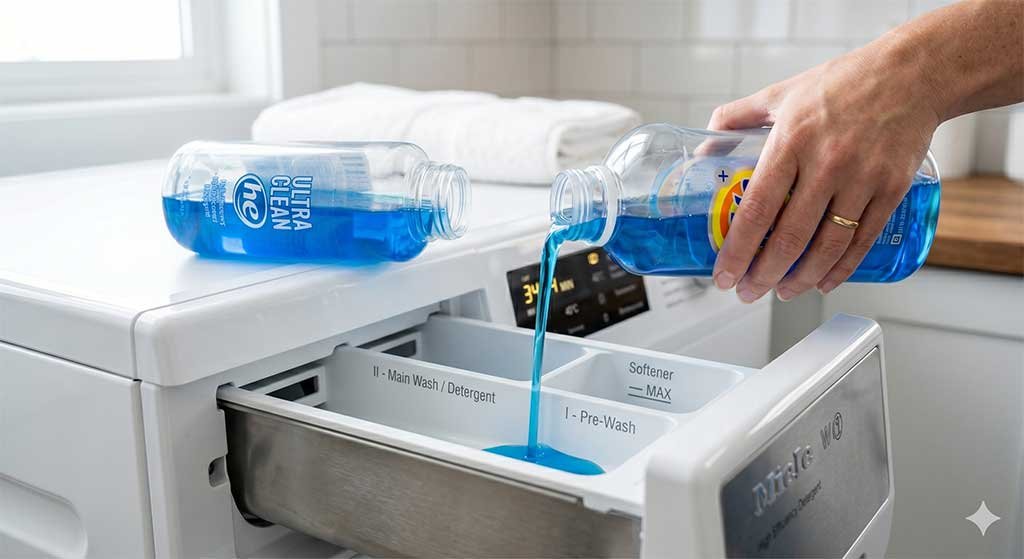
One critical rule for owning a high-efficiency washer is detergent usage. You must exclusively use HE-formulated detergents. Traditional soaps create far too many suds for the low water levels, which can cause severe mechanical damage, overflowing, and foul odors inside the drum.
4. Washer-Dryer Combos (All-in-One Solutions)
For urban dwellers, apartment renters, or anyone with strict space limitations, a washer-dryer combo is an absolute game-changer. This appliance combines a front-loading washer and a condenser dryer into a single cabinet. It is the ultimate space-saving appliance for modern homes.
The biggest advantage is the seamless transition. You can put dirty clothes in before leaving for work, and return home to a clean, fully dry load. There is no need to transfer wet clothes from one machine to another, offering incredible convenience.
Most washer-dryer combo units use ventless drying technology. Instead of venting hot air outside, they use a condenser or heat pump system to extract moisture. While the drying process takes longer than a standalone vented dryer, it allows you to install the unit anywhere with a plug and water line.
5. Portable and Compact Washing Machines
Not everyone has a dedicated laundry room. Portable and compact washing machines are designed for RVs, college dorms, and small studio apartments. These miniature units offer the convenience of at-home laundry without requiring permanent plumbing modifications or large floor spaces.
Many portable models come equipped with caster wheels, allowing you to roll them out of a closet when needed. They typically connect directly to a standard kitchen or bathroom sink faucet using a quick-connect adapter, making installation incredibly fast and painless.
Despite their small size, modern compact washers pack surprising power. While you cannot wash a king-sized comforter in them, they handle daily apparel, towels, and delicates perfectly. They are an excellent investment for anyone tired of hauling heavy baskets to the neighborhood laundromat.
Key Factors When Choosing Your Next Washing Machine
Knowing the categories is only half the battle. To find the perfect appliance, you must align the machine’s specifications with your household’s unique lifestyle. Do not overpay for features you will never use, but do not compromise on the capacity you desperately need.
Take the time to evaluate your laundry habits. How many loads do you run weekly? Are you dealing with heavy grease stains or mostly gym clothes? Let’s explore the crucial purchasing factors that dictate long-term appliance satisfaction.
Capacity Needs
Capacity is measured in cubic feet, and choosing the right size is critical. If you buy a machine that is too small, you will waste hours running multiple cycles. If you buy one that is too large, you will waste water, energy, and money on empty drum space.
For a single person or a couple, a compact 1.9 to 2.5 cubic feet machine is usually sufficient. A standard family of four should look for models between 4.0 and 4.5 cubic feet. If you frequently wash bulky king-sized bedding, seek out mega-capacity models over 5.0 cubic feet.
Energy Star Ratings
Always check the Energy Star rating before making a purchase. Appliances with this certification meet strict energy efficiency guidelines set by environmental protection agencies. While an Energy Star model might cost slightly more upfront, it pays for itself rapidly.
Calculate the long-term utility savings. An efficient machine drastically cuts down on both electricity usage and water consumption. Over a typical ten-year lifespan, these savings can amount to hundreds of dollars, making the initial investment highly worthwhile for budget-conscious homeowners.
Smart Features and App Connectivity
Modern appliances are smarter than ever. Many new models feature Wi-Fi connectivity, allowing you to monitor and control your laundry via a smartphone app. You can receive push notifications when a cycle finishes, preventing wet clothes from sitting and developing a musty odor.
Look for advanced features like auto-dosing detergent dispensers. You fill a bulk reservoir once, and the machine automatically calculates and releases the exact amount of soap needed based on load weight. AI wash sensors can even detect soil levels and adjust the cycle time automatically for perfect results.
FAQ
A drum is a rotating tub. It moves around the agitator or impeller during the wash cycle and helps the washer for better performance.
A big size washing machine is made for big washing capacity. If you don’t have enough time to wash clothes several times a week or you have huge clothes loads at a time then it will be perfect for you. But you need more energy and more water to run. Spare parts and maintenance cost is also higher for a big washing machine. If you don’t need a big capacity then it is better to go for a small size washer.
Whirlpool, LG, and Samsung are the most reliable washing machine brands. They need less repairs than others in the market.
There may also be some models of the mentioned brands that require not only frequent repairs but also face recall. So, you should consider customer reviews before making any purchase.
Generally, a front load washer spins faster than a top loader. More spin means better cleaning. It also extracts more water from the clothes and cuts the drying time than a traditional top loader.
Final Words
Is your laundry room causing you daily stress? Learn to match the different types of washing machine to your lifestyle easily! Evaluate your space limits, fix your inefficient washing routines & confidently choose the perfect model yourself.
If you prioritize heavy-duty stain removal and unparalleled energy savings, a front-load washer is your best bet. If you want fast cycles, budget-friendly prices, and ergonomic loading, stick to a reliable top-load washer.
For those living in tight quarters, a washer-dryer combo offers unbeatable all-in-one convenience. Assess your household’s daily laundry volume, calculate your available floor space, and upgrade your home with a machine that makes laundry day a breeze rather than a chore.




Leave a Reply