
Is your air fryer acting up? If you are dealing with an air fryer fan not spinning, you are in the right place. This issue can ruin your meal prep and leave your food soggy instead of crispy. Fortunately, most airflow problems are entirely fixable at home.
In this comprehensive guide, we will walk you through the exact steps to diagnose and resolve this frustrating appliance issue. We will cover everything from simple drawer misalignments to deeper hardware faults. You do not need a degree in electrical engineering to get your appliance working again.
By following our structured troubleshooting methods, you will save money and avoid buying a brand-new machine. (Plus, keeping this compact unit running instead of firing up your traditional oven is a fantastic way to reduce your overall household energy consumption). Let’s dive into the mechanics of your air fryer and get that crisping power back online today.
Table of Contents
How an Air Fryer Actually Works
To understand why your appliance is failing, you must understand how it operates. An air fryer is essentially a compact, highly efficient convection oven. It relies on a specific sequence of events to cook your food perfectly.
When you turn the machine on, electricity flows to the air fryer heating element. This thick metal coil heats up rapidly, reaching temperatures over 400°F. However, heat alone is not enough to fry your food.
This is where the internal fan motor comes into play. Positioned directly above or behind the heating coil, this motorized fan spins rapidly. It forces the intensely hot air downwards and around your food in a continuous, high-speed cycle.
If the fan fails, the heat simply rises and stays trapped at the top of the chamber. This triggers internal safety sensors, which will shut the machine down. Without airflow, the convection process stops entirely.
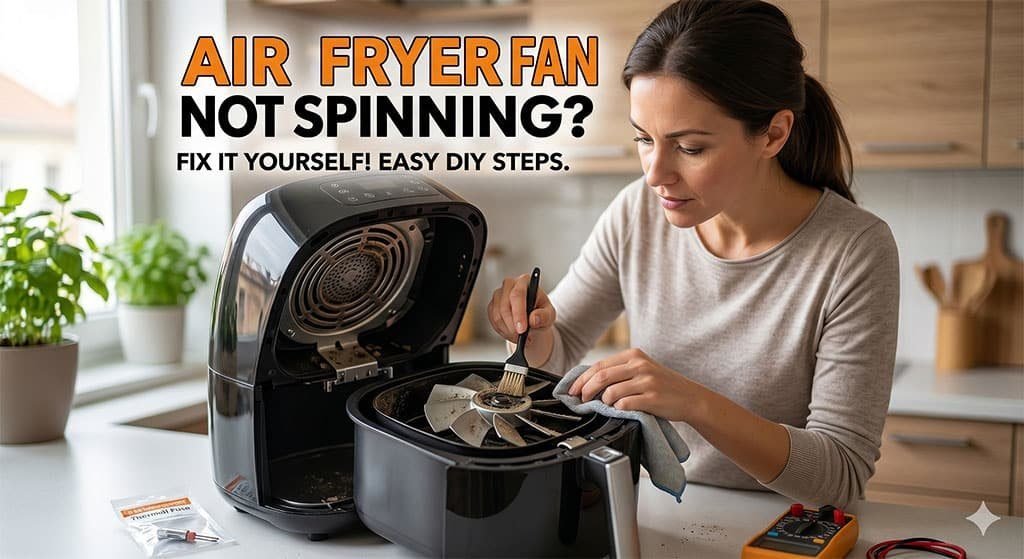
How to Verify the Fan Isn’t Working (The Airflow Test)
Before you rip the machine apart for an air fryer repair, you must confirm the fan is actually dead. Sometimes, the issue is just weak airflow caused by overcrowding the basket.
Let’s run a simple diagnostic test. First, empty the basket completely. Remove all food, aluminum foil, and parchment paper liners. The basket must be totally bare.
Next, slide the empty basket back into the unit and ensure it clicks securely into place. Set your machine to 400°F and set the timer for exactly three minutes. Press start.
Listen very closely to the machine. You should hear the distinct, loud whirring sound of the fan motor spinning up to speed. If the machine is completely silent, the fan is not engaging.
Carefully place your hand a few inches away from the rear exhaust vent. You should feel a strong, steady stream of warm air blowing outward. If you feel no air, or if the unit shuts off after thirty seconds, your fan is definitively failing.
Airflow Diagnostic Results
Sound Level | Exhaust Airflow | Diagnosis | Next Step |
Loud whirring | Strong and warm | Normal operation | Check for overloaded basket |
Silence | None | Fan motor dead / No power | Check safety switch & fuse |
Grinding noise | Weak | Fan obstructed | Clean blades and heating area |
Normal sound | None (unit shuts off) | Overheating | Clear intake/exhaust vents |
Common Causes for an air fryer fan not spinning
When your appliance stops circulating air, the root cause usually falls into one of five categories. Let’s break down the most frequent culprits responsible for this malfunction.
1. The Safety Interlock Switch is Failing
Every modern air fryer has a tiny mechanical switch located where the drawer meets the main housing. This switch ensures the fan motor and heating coil only activate when the basket is fully closed.
If your basket is warped, or if grease has glued this switch down, the machine thinks the drawer is open. Consequently, it refuses to spin the fan to prevent a fire hazard.
2. Severe Grease and Debris Buildup
Cooking high-fat foods creates atomized grease that flies around the internal cooking chamber. Over time, this sticky residue coats the metal fan blades located above the air fryer heating element.
When this grease cools, it hardens into a thick, glue-like substance. This buildup can become so dense that it physically prevents the fan blades from turning.
3. Blocked Ventilation
Air fryers need to breathe. They pull fresh room-temperature air in, heat it, and exhaust the excess pressure. If you push your appliance flush against a kitchen wall, it chokes the intake vents.
When the intake is blocked, the internal temperature spikes rapidly. The machine’s computer will deliberately stop the fan and cut power to prevent the plastic housing from melting.
4. A Blown Thermal Fuse
This is a critical safety component. The thermal fuse acts as a guardian for your kitchen. If the internal temperature exceeds safe limits, this small wire intentionally burns out to break the electrical circuit.
Once the fuse blows, the machine is dead. The display might still light up, but the fan and the air fryer heating element will receive zero power. This requires a physical part replacement. If your display does not light up at all and the machine shows zero signs of life, check out our complete guide: Air Fryer Won’t Turn On? 7 Ways to Fix It.
5. A Burned-Out Motor
While less common than grease buildup, the actual motor driving the fan can simply fail. Years of high heat and continuous vibration can wear out the internal copper windings or the motor bearings.
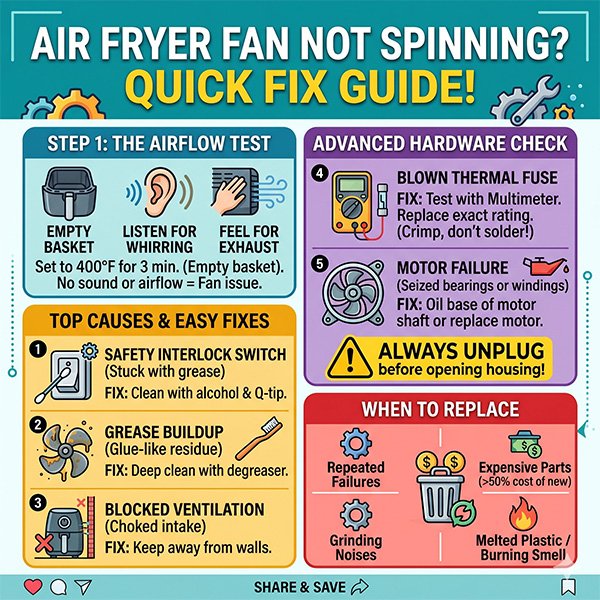
Step-by-Step Troubleshooting and Fixes
Now that we know the causes, let’s fix the problem. Follow these steps in order, moving from the easiest solutions to the more complex technical repairs.
Step 1: The 10-Minute Hard Reset
Electronic control boards can experience temporary glitches that freeze the cooking cycle. Start your troubleshooting process by resetting the appliance’s internal memory.
Unplug the machine from the wall outlet entirely. Do not just turn it off via the power button. Leave it unplugged for a full ten minutes to allow all internal capacitors to drain their charge.
Plug the unit directly into a grounded wall outlet. Do not use an extension cord or a crowded power strip, as these can restrict the voltage required to jumpstart a stuck fan.
Step 2: Inspect and Clean the Safety Switch
If the reset fails, check the drawer connection. Remove the basket and look inside the cavity of the machine. Use a flashlight to locate a small plastic tab or button along the inner rim.
This is your interlock switch. Press it gently with a wooden spoon handle. It should click in and spring back out smoothly. If it sticks, use a Q-tip dipped in rubbing alcohol to clean away the grease.
Step 3: Deep Cleaning the Chamber
If the switch is fine, we must inspect the blades. Unplug the machine and let it cool completely. Carefully turn the unit upside down so you are looking directly into the top heating chamber.
You will see the metal air fryer heating element and the fan guard. Shine a light past the guard to inspect the blades. Are they caked in brown, sticky sludge?
Use a damp microfiber cloth and a heavy-duty degreaser to carefully wipe down the visible blades. Use an old toothbrush to reach through the metal grate and scrub the stubborn spots. Do not spray liquid directly into the motor.
Advanced Air Fryer Repair Guide
If you have completed the basic cleaning and the machine still refuses to blow air, you are dealing with a hardware failure. This section is for those comfortable with basic DIY repairs.
Warning: Always ensure the appliance is unplugged for at least an hour before opening the housing. Capacitors can hold a dangerous electrical charge even when unplugged.
To access the internal components, you will need to remove the top casing. This usually involves removing several Phillips-head screws hidden under rubber screw covers or beneath the top digital display panel.
Once the top lid is off, you will see the main circuit board and the heavy wiring leading to the fan motor. Look closely for any obvious signs of damage, such as blackened wires or a burning smell.
Testing the Thermal Fuse
The most common hardware failure is the fuse. Locate a small, bullet-shaped metal component spliced into one of the main power wires leading to the heating coil. It is usually covered by a heat-resistant fiberglass sleeve.
Slide the sleeve back to expose the fuse. You will need a digital multimeter for this step. Set your multimeter to the “Continuity” setting (the symbol that looks like a sound wave).
Place one multimeter probe on each end of the thermal fuse. If the multimeter beeps, the fuse is good. If there is no sound and the screen reads “OL” (Open Loop), the fuse is blown and must be replaced.
You must replace it with a fuse of the exact same temperature rating. Crimp the new fuse into place; never solder it, as the heat from the iron will instantly destroy the new component.
Inspecting the Motor
If the fuse has continuity, the problem lies with the motor itself. Try spinning the metal blades by hand. They should spin freely with very little resistance.
If the blades are stiff or require force to turn, the motor bearings are seized. Sometimes, applying a single drop of high-heat machine oil to the base of the motor shaft can free it up.
If the blades spin freely by hand but the motor refuses to run when powered, the internal motor coils are dead. In this scenario, you must order a replacement motor specific to your machine’s model number.
When to Stop Fixing and Consider Replacing
While saving an old appliance is great, there is a point of diminishing returns. You must weigh the cost of replacement parts against the price of a brand-new unit.
If your machine requires a new logic board, a new heating coil, or a new motor, the parts alone might cost a significant amount. For a budget model, this is simply not worth the investment.
Furthermore, if your appliance has melted internal plastic, smells strongly of burning ozone when plugged in, or repeatedly blows fuses after you replace them, it is a severe fire hazard. Stop using it immediately.
Watch for these key signs that it is time to upgrade:
- Repeated Failures: You fix one issue, and another breaks a week later.
- Scratched Non-Stick Coating: The Teflon in the basket is heavily flaking into your food.
- Grinding Noises: The motor sounds like metal scraping on metal, indicating total bearing failure.
- Costly Parts: The required replacement parts cost more than 50% of a new machine.
If you decide to upgrade, look for models with improved ventilation and easily removable fan guards for better long-term maintenance. Upgrading can save you endless repair headaches.
Bottom Line
Dealing with an air fryer fan not spinning can be a major annoyance, but it does not have to mean the end of your appliance. As we have covered, most issues stem from simple user errors or lack of maintenance.
By checking your safety interlock switch, keeping the internal chamber free of heavy grease, and ensuring proper kitchen ventilation, you can prevent this issue from occurring in the first place. Regular cleaning is your best defense.
If you do face a hardware failure, replacing a thermal fuse is an inexpensive and straightforward fix for those willing to open up their machine. Always prioritize safety and unplug the unit before attempting any DIY work.
We hope this guide has given you the confidence to tackle your appliance issues head-on. Don’t let a minor malfunction keep you from enjoying your favorite crispy meals. Get in there, diagnose the problem, and get back to cooking!




Leave a Reply