
Are you struggling to get that perfect fade or a sharp neckline at home? Choosing between a beard trimmer vs hair clipper is the most critical decision in your daily grooming routine. Using the wrong device often leads to tugged hairs, patchy lines, and severe skin irritation.
Many guys assume these grooming tools do the exact same job. They look remarkably similar sitting on your bathroom counter, right? But underneath that plastic casing, their motors and blades are built for entirely different purposes.
If you want barbershop-quality results without paying premium prices, you need to understand how these machines actually work. Let’s break down the mechanics, blade widths, and exact scenarios where you need each tool.
By the end of this comprehensive guide, you will know exactly what device to buy to protect your skin and elevate your style.
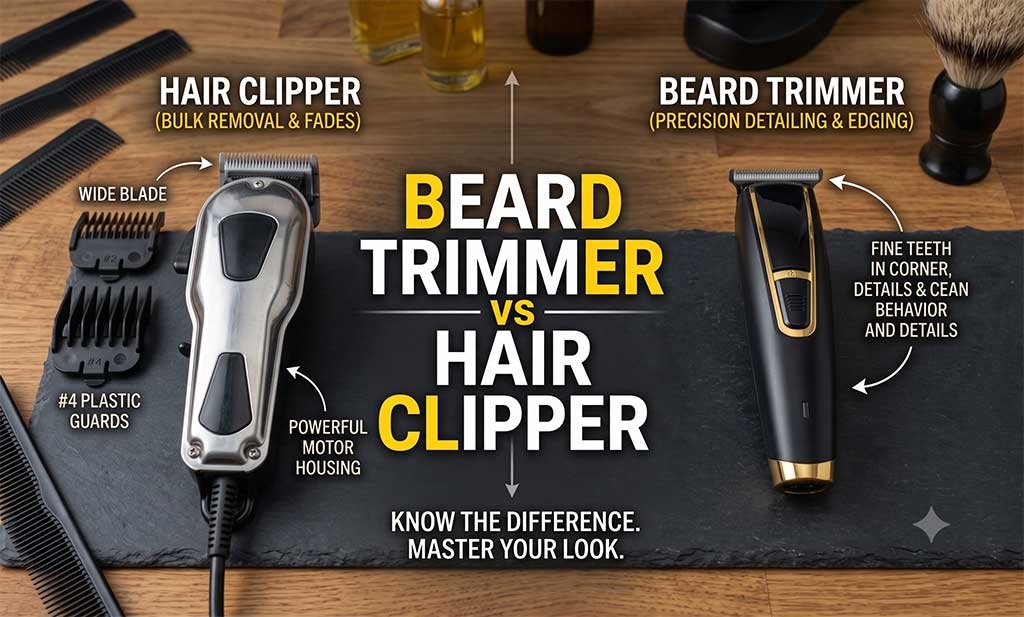
Table of Contents
Core Difference: Beard Trimmer vs Hair Clipper Explained
To master your personal styling, you first need to understand the fundamental engineering behind these two devices. They are not interchangeable. One is built for heavy-duty clearing, while the other is designed for microscopic precision.
What is a Hair Clipper? (The Bulk Remover)
A hair clipper is the ultimate workhorse of the barbering world. It is specifically designed to cut large volumes of thick, dense hair on your head quickly and efficiently.
Think of a hair clipper as a heavy-duty lawnmower. You use it when you need to clear a large area of tall grass without the engine bogging down.
These devices feature significantly wider blades, usually measuring between 1.5 to 2 inches across. The teeth on these blades have deeper spacing. This allows long, thick strands of hair to feed into the cutting mechanism without snagging or pulling.
Internally, hair clippers utilize high-torque motors. Whether they use a magnetic motor or a pivot motor, they are engineered to push through wet, thick, or coarse hair without stalling.
Best used for:
- Executing full haircuts at home.
- Creating seamless fades and tapers.
- Taking down a massive, wizard-length beard before detailed shaping.
What is a Beard Trimmer? (The Detailer)
If a clipper is a lawnmower, a beard trimmer is the precision edger you use to make the driveway lines look perfectly crisp. These are detailing tools built exclusively for shorter hair and delicate areas.
Trimmers are noticeably lighter and more compact. This ergonomic design allows you to easily maneuver around the complex angles of your jawline, chin, and mustache.
They typically feature a much narrower cutting head. Most high-quality models utilize a T-blade design. This exposed blade style allows you to see exactly where the cutting edge meets the skin for pinpoint accuracy.
The teeth on a trimmer blade are extremely fine and shallow. Because they cut so close to the skin, they are ideal for sharp line-ups, stubble maintenance, and edging.
Best used for:
- Maintaining a short, corporate beard or heavy stubble.
- Carving out sharp necklines and cheek lines.
- Detailing around the lips and mustache.
Can You Use a Hair Clipper on Your Beard? (And Vice Versa)
This is the most common question I get from guys trying to save money by buying just one tool. The short answer is yes, you can. The realistic answer is that you probably shouldn’t. Let’s look at why crossing these tools over usually ends in disaster.
The Danger of Clippers on Facial Skin
Using a massive hair clipper on your face is risky. Clipper blades are incredibly aggressive. Because the teeth are spaced wider to accept thick head hair, the loose, sensitive skin on your neck can easily get caught between them.
This causes micro-abrasions, redness, and painful razor bumps (medically known as pseudofolliculitis barbae). (If you or your partner are tackling sensitive body areas prone to similar irritation, explore our top picks for the best razor for women’s underarms to stop bumps completely.) You also completely lose the ability to see what you are doing around your mustache because the blade housing is too bulky.
The Problem with Trimmers on Head Hair
Conversely, trying to buzz your entire head with a beard trimmer is an exercise in misery. Trimmers use smaller, faster rotary motors. They simply lack the raw torque required to chop through dense head hair.
If you try to cut a full head of hair with a trimmer, the blades will quickly choke. The motor will bog down, and the device will start aggressively pulling and tugging the hair out by the root instead of cutting it. It is painful, and it will likely burn out the trimmer’s motor.
Technical Comparison: Trimmer vs Clipper Mechanics
To make the best purchasing decision, you need to see exactly how these grooming tools stack up against each other on a technical level. Here is a quick breakdown of their core specifications.
Feature | Hair Clipper | Beard Trimmer |
Blade Width | 1.5 to 2 inches (Wide for bulk) | 1 to 1.25 inches (Narrow for detail) |
Blade Teeth Spacing | Deep and wide (Feeds long hair) | Fine and shallow (Prevents skin cuts) |
Motor Type | High-torque magnetic motor or pivot | High-speed lightweight rotary motor |
Cutting Closeness | Leaves light stubble | Cuts nearly down to the bare skin |
Primary Use | Bulk removal, head hair, fades | Detailing, edging, facial hair |
Attachments | Large snap-on clipper guards | Built-in adjustable dials or micro-guards |
The Guard Size Trap: Why Clipper Guards and Trimmer Settings Don’t Match
This is the number one mistake guys make that completely ruins their facial hair. Do not assume that a “Number 2” guard on a clipper is the same length as a “Number 2” setting on a beard trimmer dial.
On a standard hair clipper, guard sizes directly correspond to fractions of an inch. A #1 guard leaves 1/8 of an inch of hair. A #2 guard leaves 1/4 of an inch, and so on. These are standardized across most major barbering brands.
However, beard trimmers usually measure length in millimeters. If you set your trimmer dial to a “2”, it almost always means 2 millimeters.
For context, 2 millimeters is significantly shorter than a clipper’s #2 guard (which is about 6.3 millimeters). If you switch from a clipper to a trimmer and use the same number, you will accidentally shave off months of beard growth in a single swipe. Always read your specific manual.
Which Grooming Tool Should You Buy? (Purchase Scenarios)
Still not sure which device belongs in your bathroom cabinet? Let’s look at three common lifestyle scenarios to help you make the right investment.
Scenario A: The Stubble Look
Your Routine: You visit the barber every two weeks for a haircut, but you maintain your own facial hair at home. You prefer the heavy stubble look or a tightly cropped corporate beard.
The Verdict: You absolutely need a high-quality beard trimmer. Look for one with a precision dial and a lithium-ion battery. You do not need a hair clipper, as your barber handles the heavy lifting on your head.
Scenario B: The DIY Barber
Your Routine: You are tired of paying for haircuts and have decided to start buzzing your own head or fading your own hair at home. You also have a massive, lumberjack-style beard that only needs occasional bulk reduction.
The Verdict: Buy a heavy-duty hair clipper. A professional-grade clipper will easily buzz your head and can take down the bulk of your long beard when necessary. You can use grooming scissors to clean up the stray hairs on your mustache and cheeks.
Scenario C: The Perfectionist
Your Routine: You cut your own hair, but you also demand barbershop-level crisp lines on your cheeks, a zero-gapped bald fade on the sides, and a perfectly edged neckline.
The Verdict: You need a clipper and trimmer combo set. There is no getting around it. You need the wide blades of the clipper to remove the bulk hair, and you need a zero-gap trimmer to create those razor-sharp, skin-tight lines around the edges.
How to Maintain Your Blades for Maximum Lifespan
Whether you invest in a clipper or a trimmer, the secret to a pain-free grooming experience is blade maintenance. A dirty, un-oiled blade will pull hair and destroy your skin, regardless of how powerful the motor is.
After every single use, take a small brush and sweep out all the trapped hair from the blade housing. Hair buildup absorbs moisture and causes the metal components to rust from the inside out.
Next, you must oil your blades. This is non-negotiable. Turn the device on and place exactly three drops of clipper oil across the teeth (left, center, and right). Let it run for ten seconds to distribute the oil.
This simple routine reduces metal-on-metal friction. It keeps the motor running cool, preserves battery life, and ensures the blades stay razor-sharp for years of continuous use.
Bottom Line
Ultimately, choosing between a beard trimmer vs hair clipper comes down to the volume of hair you are managing and the level of precision your style requires. Think of a hair clipper as the powerful machine designed to efficiently clear dense bulk, while a beard trimmer is your detailing tool used for those fine, skin-tight finishing touches.
If you are exclusively maintaining facial hair and demand sharp, clean lines, a dedicated beard trimmer is your non-negotiable tool. However, if you are executing full haircuts at home or taking down significant length, you must invest in a robust hair clipper.
Stop compromising your skin health and ruining your style with the wrong device. Evaluate your specific daily grooming routine, purchase the purpose-built tool for your exact needs, and take total control of your personal maintenance today.


![Is It Better to Epilate or Shave Legs? [Pros & Cons]](https://roundtheyear.com/wp-content/uploads/2026/08/Is-It-Better-to-Epilate-or-Shave-Legs-Pros-Cons-Final-Verdict.jpg)
Leave a Reply