
Rising energy bills have many homeowners questioning their daily kitchen habits. If you are trying to cut down your monthly utility expenses, you might wonder: do air fryers save money on electricity? The short answer is yes, switching to this countertop appliance can noticeably lower your power consumption.
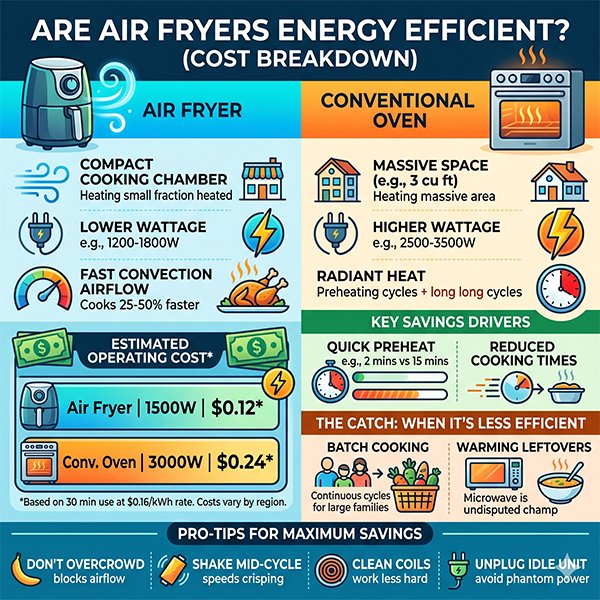
Traditional electric ovens require massive amounts of energy to preheat and maintain high cooking temperatures. Because an air fryer uses a compact cooking chamber combined with rapid convection airflow, it cooks meals in a fraction of the time, dramatically reducing your household energy consumption.
Do Air Fryers Save Money on Electricity? The Direct Verdict
To understand why this kitchen appliance is so efficient, we have to look closely at appliance wattage and thermal dynamics. A standard conventional wall oven typically operates between 2,500 and 3,500 watts of power. In stark contrast, an average countertop air fryer uses only 1,200 to 1,800 watts during operation.
Beyond the raw wattage numbers, the secret lies in volumetric space. An oven must heat up roughly three cubic feet of air space before it even begins cooking your food. An air fryer only needs to heat a tiny fraction of that area, completely eliminating long, wasteful preheating cycles.
How Much Electricity Does an Air Fryer Actually Use?
To figure out your exact financial savings, you need to understand how utility companies bill your home. Power companies charge by the kilowatt-hour (kWh). You can calculate your consumption by multiplying the appliance wattage by cooking hours, then dividing by 1,000.
Let us look at a practical example using a standard electricity rate of $0.16 per kWh. If you run a 1,500-watt air fryer for 30 minutes, it consumes 0.75 kWh of electricity. This brings the total operating cost to just $0.12 per cooking session.
Appliance Energy Consumption Comparison
The chart below outlines how different cooking methods stack up over a typical 30-minute cooking cycle at a standard national utility rate.
Kitchen Appliance | Average Wattage | Preheat Time Required | Energy Used (30 Mins) | Average Cost Per Use |
Standard Air Fryer | 1,500 Watts | 2 Minutes | 0.75 kWh | $0.12 |
Conventional Oven | 3,000 Watts | 15 Minutes | 1.50 kWh | $0.24 |
Toaster Oven | 1,200 Watts | 5 Minutes | 0.60 kWh | $0.10 |
Countertop Microwave | 1,000 Watts | 0 Minutes | 0.50 kWh | $0.08 |
When Do Air Fryers Save You the Most Money?
An air fryer delivers the highest return on investment when preparing daily meals for small to medium households. If you are regularly cooking quick dinners for one to four people, avoiding your main oven completely maximizes your financial return.
Cooking Small to Medium Portions
Preparing a couple of chicken breasts or a single batch of french fries in a large oven is highly inefficient. The air fryer concentrates all its thermal energy directly onto the food, ensuring no heat is wasted on empty space.
Skipping the Preheating Phase
Most modern countertop convection units reach their target cooking temperature within two minutes. Eliminating the fifteen-minute warm-up cycle required by conventional heating systems prevents your electric meter from spinning rapidly before food even enters the kitchen.
Shorter Overall Cooking Times
The rapid air circulation technology mimics deep frying by moving superheated air around your food at high velocities. This accelerated heat transfer cuts standard oven cooking times down by 25% to 50% for most common recipes, even when you are safely preparing unthawed cuts of poultry or beef directly from the icebox.
The Catch: When Is an Air Fryer Less Efficient?
While these compact convection devices are highly efficient, they are not a perfect magic bullet for every single scenario. Understanding their engineering limitations will prevent you from accidentally driving up your utility bills through improper usage.
Batch Cooking for Large Families
If you have to feed a large gathering, a standard four-quart basket will quickly become a major bottleneck. Cooking four consecutive batches of food keeps the appliance running continuously for two full hours, wiping out any inherent energy savings.
Microwave vs. Air Fryer Efficiency
When it comes to simply warming up yesterday’s leftovers or heating liquids, the classic microwave remains the undisputed champion. A microwave targets water molecules directly, meaning it uses less total power than any heating element for short tasks.
Practical Tips to Maximize Kitchen Energy Savings
- Avoid Overcrowding the Basket: Piling food too high blocks the internal airflow patterns, extending your required cook time and wasting electricity.
- Shake the Basket Mid-Cycle: Quickly shaking your ingredients ensures uniform heat distribution, which speeds up the crisping process significantly.
- Clean the Heating Element: Grease and carbon buildup on the top heating coils force the internal elements to work harder to maintain target temperatures.
- Unplug the Unit When Idle: Many modern digital kitchen appliances draw small amounts of phantom standby power when left plugged into the wall.
Regional Utility Rate Impacts on Appliance Savings
Your geographic location plays a massive role in determines exactly how much cash you keep in your pocket. Electricity tariffs vary wildly across different states and countries, directly scaling the financial impact of your kitchen choices.
If you reside in a region with incredibly high baseline utility rates, every single kilowatt-hour saved keeps more money in your bank account. In these high-cost zones, moving your daily cooking away from a heavy-duty wall oven yields massive annual dividends.
Dynamic Energy Consumption Breakdown
To make it incredibly simple to calculate your exact home utility costs, explore our interactive breakdown below. You can adjust the parameters to match your specific home appliances, local electricity rates, and weekly cooking routines to see your potential savings grow.
Bottom Line
When assessing modern appliance options, it is completely undeniable that do air fryers save money on electricity over the course of a year. By reducing preheating times, running at a lower native wattage, and speeding up overall recipe completion times, they offer an easy way to optimize your household budget.
While they cannot completely replace a full-sized conventional oven for massive holiday feasts or large-scale batch baking, they excel at managing daily meals. Integrating a high-efficiency countertop convection unit into your cooking pipeline is a smart, actionable step toward building a sustainable, low-cost household.




Leave a Reply