
Upgrading your laundry room often comes down to choosing between two South Korean tech giants. If you are comparing lg vs samsung washer and dryers, you are not alone. Both brands dominate the market with sleek designs, smart home features, and powerful cleaning cycles.
Making the right choice requires looking past the shiny touchscreens and marketing jargon. You need to consider long-term durability, wash performance, parts availability, and customer support. In this comprehensive guide, we break down everything you need to know.
We will look at real-world cleaning performance, maintenance costs, and the latest heat-pump combo technology. By the end of this guide, you will know exactly which brand deserves your hard-earned money and a spot in your home this year.
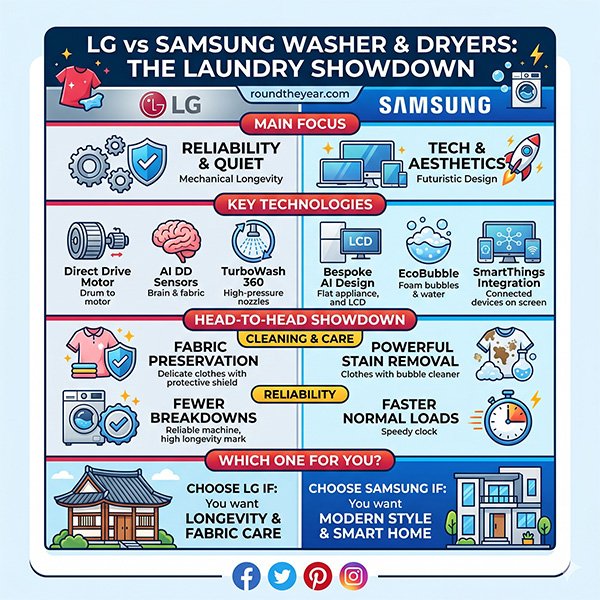
Table of Contents
LG vs Samsung Washer and Dryers: Quick Comparison
Before diving into the deep technical details, let’s look at a high-level comparison. Both brands offer incredible laundry appliance technology, but their core strengths appeal to different types of households.
Feature | LG Appliances | Samsung Appliances |
Core Strength | Mechanical reliability and quiet operation | Smart home integration and aesthetics |
Motor Type | Direct Drive (attached to drum) | Digital Inverter (belt-driven on some models) |
Smart App | LG ThinQ | Samsung SmartThings |
Design Style | Traditional premium | Ultra-modern, flat-panel Bespoke |
Vibration | Very low (TrueBalance technology) | Low (VRT Plus technology) |
LG Washers and Dryers: The Case for Reliability
LG has spent the last decade building a reputation for building the most reliable front load washing machines on the market. They consistently score at the top of appliance repair technician recommendation lists. For a deeper look at how their base laundry engineering competes across all models, checking out a dedicated samsung vs lg washing machine analysis can give you a better view of their mechanical differences.
The primary reason for this reliability is their engineering approach. LG focuses on minimizing moving parts, which naturally reduces the points of potential failure over a ten-year lifespan.
Core LG Technologies
- Direct Drive Motor: Instead of using belts and pulleys, the motor attaches directly to the drum. This drastically reduces wear and tear, noise, and severe vibrations during the spin cycle.
- TurboWash 360: This feature uses high-pressure twin nozzles to spray clothes from multiple angles. It allows you to complete a thorough wash cycle in under 30 minutes without losing cleaning power.
- AI DD (Artificial Intelligence Direct Drive): Built-in sensors detect the weight and the softness of the fabric in the drum. The machine then automatically selects the optimal washing motion to protect delicate clothes.
Pros of LG
- Exceptionally low breakdown rate within the first five years.
- Excellent parts availability for third-party repair technicians.
- Highly effective gentle cycles that extend the life of your wardrobe.
Cons of LG
- Designs can feel slightly less futuristic compared to competitors.
- The ThinQ app, while functional, lacks the deep ecosystem integration of its rivals.
Samsung Washers and Dryers: The Smart Home Kings
Samsung approaches laundry equipment like consumer electronics. If you want a laundry room that looks like a spaceship and integrates flawlessly with your smartphone, Samsung is the undeniable leader.
Their Bespoke laundry lineup has completely changed home appliance design. With flat panels, hidden controls, and premium color options, these machines are built for modern, upscale homes.
Core Samsung Technologies
- Bespoke AI Design: The minimalist, flat-panel aesthetic allows these machines to blend seamlessly into custom cabinetry. They feature an AI Hub LCD touchscreen that learns your favorite cycles.
- EcoBubble Technology: This system mixes air, water, and detergent to create a thick foam before the cycle begins. The bubbles penetrate fabrics up to 40 times faster, allowing for deep cleaning even in cold water.
- SmartThings Integration: The machines connect flawlessly to the Samsung SmartThings ecosystem. You can receive cycle alerts on your Samsung TV, smartphone, or smartwatch, making laundry management effortless.
Pros of Samsung
- Industry-leading aesthetic design with premium color choices.
- Unmatched smart home connectivity and energy monitoring.
- The Super Speed cycle can wash and dry loads incredibly fast.
Cons of Samsung
- Historically higher rates of service calls compared to LG.
- Finding authorized service technicians in rural areas can be challenging.
LG vs Samsung Washer and Dryers: Head-to-Head Showdown
Now that we understand the core philosophies of both brands, let’s pit them against each other in the categories that matter most to your daily routine.
Cleaning Performance and Fabric Care
When it comes to raw stain removal, both brands are spectacular. Samsung’s EcoBubble technology excels at lifting heavy, set-in stains like mud or grease during intensive cycles.
LG, however, takes the crown for fabric preservation. The 6-Motion technology combined with the AI DD sensors ensures that your expensive garments are not aggressively tumbled when they only need a light refresh.
If you wash a lot of heavy workwear, Samsung’s aggressive agitation is a bonus. If your wardrobe consists of delicate fabrics, knits, or professional attire, LG is the safer choice.
Long-Term Reliability and Maintenance
This is the most critical category for most buyers. Nobody wants to deal with a flooded laundry room or a broken control board. Based on service technician data, LG holds a distinct advantage here.
LG’s direct drive technology simply breaks down less often. Furthermore, when an LG machine does need a repair, parts are widely distributed. Almost any local appliance repair company can source LG components quickly.
Samsung has improved its build quality with the recent Bespoke line, offering 20-year motor warranties. However, their reliance on complex internal electronics means that when they do fail, the repairs can be expensive and require specialized technicians.
Ventless Heat-Pump Combos
The biggest innovation in the best washer dryer combo market is the shift toward 110-volt, ventless heat-pump units. Both brands have released massive flagship models: the LG WashCombo and the Samsung Bespoke AI Laundry Combo.
Samsung wins on raw speed for normal loads. Their combo can wash and dry a standard load in under 100 minutes. The massive 7-inch LCD screen makes selecting cycles incredibly intuitive.
However, LG handles bulky items and heavy bedding much better. Independent tests show Samsung sensors can struggle with thick comforters, occasionally leaving them damp. LG’s heat-pump system, while slightly slower overall, provides more consistent, thoroughly dried loads.
Ease of Use and Control Panels
The user interface of your appliance dictates how frustrating laundry day will be. LG favors a more traditional approach. They utilize a large, tactile central dial accompanied by clearly labeled digital touch buttons.
This hybrid approach ensures that anyone, regardless of their tech-savviness, can walk up to an LG machine and start a wash cycle immediately. The ThinQ app serves mostly as a backup for notifications.
Samsung has fully embraced the digital age. Their flagship models feature the AI Hub, a large, full-color touchscreen display. While this looks stunning and modern, it requires a slight learning curve.
If you love smartphones and touch interfaces, Samsung’s controls will feel like a massive upgrade. If you prefer physical dials and simple menus, LG’s interface will feel far more comfortable and less overwhelming.
Energy Efficiency and Sustainability
Both South Korean brands lead the industry in energy efficiency, easily securing top Energy Star certifications. However, their approaches to saving you money on utility bills differ slightly.
LG’s primary energy-saving feature is its motor efficiency. By reducing mechanical friction, the machine draws less electricity per cycle. Their TrueSteam technology also reduces the need for hot water heating on certain cycles.
Samsung takes a software-driven approach to efficiency. The SmartThings app features an “AI Energy Mode.” This mode actively monitors your electricity usage and optimizes the cycle run times to use up to 60% less energy during the drying phase.
If you are an absolute data nerd who wants to track the exact kilowatt-hour usage of every load of laundry, the Samsung smart washer features provide unmatched visibility into your home’s energy footprint.
Final Verdict and Recommendations
The battle between these two appliance giants does not have a single, definitive winner. The right choice depends entirely on your household’s specific needs, your budget, and your tolerance for technology.
If your primary goal is finding an appliance that will run quietly and flawlessly for the next decade with minimal maintenance, LG is the superior choice. Their mechanical engineering and fabric care algorithms are currently unmatched.
If you are building a futuristic smart home, prioritize aesthetic design, and want the absolute fastest cycle times available, Samsung is the brand for you. The Bespoke lineup offers a premium, integrated experience that traditional appliances cannot touch.
Choosing between an lg vs samsung washer and dryers ultimately comes down to prioritizing either mechanical reliability or cutting-edge digital features. Evaluate your daily laundry habits, consider the layout of your home, and choose the brand that best aligns with your lifestyle.




Leave a Reply