
You have probably heard the hype. Everyone seems to be ditching their ovens for these compact countertop cookers. But with rising energy costs, a sensible question pops up in your mind: does air fryer use a lot of electricity?
You are not alone in wondering if this convenient gadget is secretly spiking your utility bill. The good news is that you can likely breathe a sigh of relief.
In this guide, we will break down exactly how much power your air fryer consumes, compare it to other appliances, and show you the math so you can see the savings for yourself.

Table of Contents
Quick Answer: Air Fryer vs. The Rest
When you look at the raw numbers, an air fryer might seem power-hungry. Most standard models use between 1,500 and 1,700 watts. This is actually comparable to a space heater or a high-end hair dryer.
However, power usage is not just about wattage. It is about time.
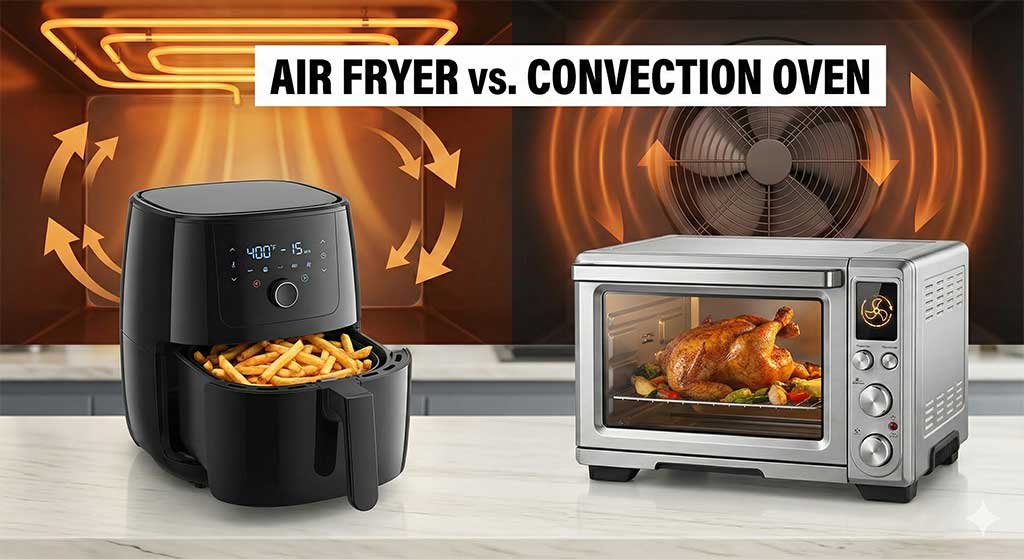
Think about your traditional electric oven. It is a massive insulated box that takes 15 to 20 minutes just to reach 400°F. Then, it has to maintain that heat for an hour to roast a chicken. That is a lot of wasted energy heating up empty space.
In contrast, your air fryer is compact. The heating element is right next to the food. It hits top temperature in under 3 minutes and circulates hot air rapidly. That same chicken might be done in 45 minutes or less. Because you run it for less time, you use less electricity overall.
How Much Does It Actually Cost to Run?
Let’s get practical. To understand the real cost, you need to know three things:
- The Wattage of your air fryer.
- The Time you cook.
- Your Electricity Rate (measured in cents per kilowatt-hour, or kWh).
As of 2025, the average electricity rate in the US is roughly $0.19 per kWh.
Calculation Formula
$$Cost = \frac{\text{Wattage}}{1000} \times \text{Hours Used} \times \text{Electricity Rate}$$
Let’s say you have a 1,500-watt air fryer and you use it for 30 minutes (0.5 hours) every day.
- Step 1: $1,500 / 1000 = 1.5 \text{ kW}$
- Step 2: $1.5 \text{ kW} \times 0.5 \text{ hours} = 0.75 \text{ kWh}$
- Step 3: $0.75 \text{ kWh} \times \$0.19 = \$0.14$
It costs you about 14 cents to use your air fryer for half an hour. If you use it every single day for a month, that is only about $4.20.
Comparison: Air Fryer vs. Oven vs. Microwave
To give you a clearer picture, let’s compare the most common kitchen appliances. This table assumes you are cooking a standard meal like roasted potatoes or chicken wings.
Appliance | Average Wattage | Cooking Time | Est. Cost (per use) |
Air Fryer | 1,500 W | 20 Mins | $0.09 |
Electric Oven | 3,000 W | 45 Mins | $0.43 |
Microwave | 1,000 W | 5 Mins | $0.02 |
Deep Fryer | 1,800 W | 30 Mins | $0.17 |
Note: Estimates are based on an average rate of $0.19/kWh. Actual costs may vary depending on your location and specific appliance model.
As you can see, the microwave is the king of efficiency because it cooks so fast. But you can’t roast a crispy chicken in a microwave. When you compare the air fryer to the electric oven—its true competitor—the air fryer is clearly the winner. You save money every time you choose the smaller basket over the big oven door.
Factors That Affect Your Air Fryer’s Energy Use
Not all air fryers are created equal. Several factors determine if your specific model is an energy saver or a power hog.
1. Size Matters
A massive 10-quart dual-basket air fryer will naturally use more power than a compact 2-quart model. If you live alone, a smaller unit is more energy efficient because it heats up faster and uses fewer watts to maintain the temperature.
2. Temperature Settings
Cooking at 400°F uses more electricity than cooking at 325°F. The heating element has to work harder to keep the air scorching hot. However, since higher heat often means shorter cooking times, this usually balances out.
3. Basket Capacity and Airflow
If you overfill the basket, the hot air cannot circulate freely. This leads to uneven cooking. You will end up opening the drawer, shaking the basket, and adding more minutes to the timer. This wastes heat and electricity. Always cook in a single layer for the best results and efficiency.
Always cook in a single layer for the best results and efficiency. Similarly, be careful not to suffocate the fan with heavy accessories. (Read our guide on choosing the correct liner to ensure you aren’t accidentally blocking the heat and wasting electricity).
Tips to Lower Your Electricity Bill Even Further
You already know that using an air fryer saves money. But you can maximize those savings with a few smart habits.
- Skip the Preheat: Unlike ovens, most air fryers do not need a strict preheat cycle. Unless you are baking a cake, just toss the food in and turn it on. You save 3-5 minutes of electricity instantly.
- Clean It Regularly: A buildup of grease and crumbs on the heating element can make your appliance work harder. A clean machine is an efficient machine.
- Cut Food Smaller: Smaller pieces cook faster. If you dice your potatoes into 1-inch cubes instead of 2-inch chunks, you might shave 5 minutes off the run time.
- Keep it Plugged Out: Some modern air fryers with digital displays have a “phantom load.” They draw a tiny amount of power even when off to keep the clock running. Unplug it when you are done to stop this energy leak.
Is an Air Fryer Right for You?
If your main goal is to save money on electric bills, the air fryer is a solid investment. To maximize your upfront savings, you don’t even need a pricey model; there are plenty of the best air fryers under $100 that are incredibly energy efficient. This is especially true if you currently use a large electric oven for small meals.
Imagine you want to reheat two slices of pizza.
- Oven: You heat up the whole box. It takes 15 minutes to preheat and 10 minutes to cook.
- Air Fryer: You heat up a shoebox-sized space. It takes 3 minutes.
The difference adds up over a year. While it won’t make you rich, it definitely keeps more dollars in your pocket. Plus, during the summer, an air fryer won’t heat up your entire kitchen like an oven does, saving you even more on air conditioning costs.
Common Myths About Kitchen Energy Use
Myth 1: “Higher wattage always means higher cost.”
Not true. A 1,800-watt air fryer might cook your steak in 8 minutes, while a 1,200-watt halogen oven might take 20 minutes. The high-wattage device is actually cheaper here because it is faster.
Myth 2: “Gas ovens are always cheaper.”
Gas is often cheaper than electricity per unit, but gas ovens are notoriously inefficient at retaining heat. An electric air fryer transfers heat so directly that it often competes well with gas ovens in terms of total cost per meal, without the fumes.
FAQ
It is almost always cheaper to run an air fryer. An air fryer uses roughly half the energy of an electric oven for the same meal because it cooks faster and has a much smaller space to heat.
Most standard air fryers use between 1,500 and 1,700 watts. Smaller “personal” size models may use around 800 to 1,000 watts, while large family-sized units can reach up to 1,800 watts.
Yes, but only a small amount. If your air fryer has a digital clock or a standby light, it consumes “vampire power” while plugged in. Unplugging it when not in use stops this small waste.
Yes. By switching from a traditional oven to an air fryer for daily cooking—especially for smaller meals like chicken tenders, fries, or roasted vegetables—you can lower your monthly kitchen energy usage.
Based on average US electricity rates of $0.19/kWh, running a 1,500-watt air fryer for 30 minutes costs approximately 14 cents.
Bottom Line
So, does air fryer use a lot of electricity compared to other appliances? No, it is one of the most efficient tools in your kitchen. By cooking faster and focusing heat directly on your food, it saves both time and energy. If you replace daily oven use with an air fryer, you will see a noticeable drop in your energy consumption over time.



Leave a Reply