
If you have limited counter space and a hunger for crispy food, you’ve likely faced the dilemma: should you get an air fryer, or stick with a convection oven? It’s a debate that confuses many home cooks because, technically, they use similar technology.
However, the cooking experience is vastly different. While both appliances use fans to circulate hot air, the Air Fryer vs. Convection Oven battle comes down to speed, capacity, and that coveted “crunch.” In this guide, we will break down exactly how they differ, the pros and cons of each, and help you decide which one deserves a spot in your kitchen.
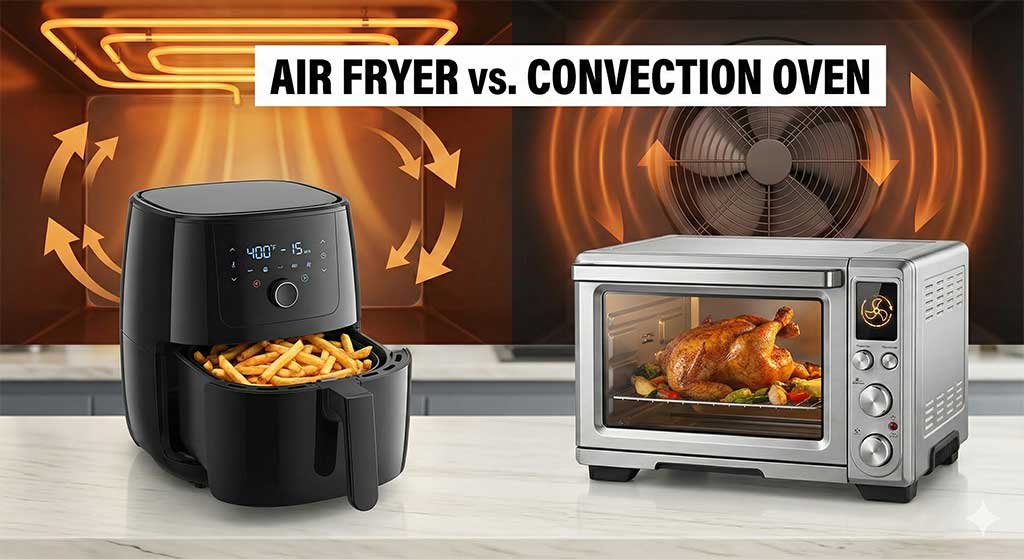
Table of Contents
What is a Convection Oven?
A convection oven looks like a traditional thermal oven but has a secret weapon: a fan and exhaust system. In a regular oven, heat simply radiates from heating elements (usually at the bottom). In a convection oven, the fan blows that hot air around the food.
This circulation eliminates “hot spots” and “cold spots,” ensuring that your food cooks evenly and faster than it would in a standard oven. It is essentially the workhorse of the kitchen, capable of handling everything from delicate meringues to a massive Thanksgiving turkey.
Best Used For:
- Roasting large cuts of meat or whole chickens.
- Baking multiple trays of cookies at once (since the heat is even on all racks).
- Roasting vegetables for dinner parties.
What is an Air Fryer?
Don’t let the name fool you—an air fryer doesn’t actually “fry” food. Instead, it is a high-intensity, compact convection oven. The magic lies in its size and speed. Because the cooking chamber is small and the fan is incredibly powerful, hot air hits the food with much more intensity than in a full-sized oven.
This rapid air circulation mimics the results of deep-frying by quickly removing moisture from the surface of the food, creating a crispy, golden-brown layer with little to no oil. Because there are so many models on the market utilizing this technology, deciding between a Ninja vs Cosori air fryer is often the first major choice home cooks have to make.
Best Used For:
- Frozen foods (french fries, chicken nuggets, mozzarella sticks).
- Reheating leftovers (far superior to a microwave).
- Small batches of proteins like salmon fillets or chicken wings.
Air Fryer vs. Convection Oven: Key Differences
To help you visualize the comparison, here is a quick breakdown of how these two appliances stack up against each other.
Feature | Air Fryer | Convection Oven |
Heating Mechanism | High-speed fan, heat source very close to food | Standard fan, heat circulating in large chamber |
Preheat Time | Instant to 3 minutes | 10–20 minutes |
Cooking Speed | Very Fast (cooks 20-30% faster) | Moderate (faster than standard bake) |
Capacity | Small (2–6 Quarts) | Large (Full baking sheets) |
Texture | Super crispy (fried-like) | Browned and roasted |
Noise | Loud (like a vacuum or hair dryer) | Quiet hum |
Deep Dive: Performance Breakdown
1. Cooking Speed and Efficiency
When it comes to pure speed, the air fryer wins hands down. Because the heating element is located directly above the food basket, there is almost no heat loss. If you want to make a quick dinner on a Tuesday night, the air fryer is your best friend.
In contrast, the Air Fryer vs. Convection Oven debate shifts when you are cooking for a crowd. A convection oven takes longer to heat up, but you can cook three racks of food simultaneously. An air fryer requires you to cook in batches, which can actually take longer if you are feeding a family of five.
Related Reading: Curious about the actual running costs? Find out exactly how much money an air fryer saves on electricity compared to a conventional oven.
2. Taste and Texture
Do you crave that specific “fried” crunch? An air fryer delivers a texture that is 80-90% similar to deep-frying. It is excellent at making things like breaded chicken or frozen fries taste indulgent.
A convection oven, however, excels at roasting. It will give you crispy skin on a chicken or browned edges on potatoes, but it won’t achieve that shattering, deep-fried crunch that an air fryer can produce.
3. Health Benefits
Both appliances allow you to cook with less fat than deep frying. However, air fryers are specifically designed to allow oil to drip away from the food into a basket below. If this excess fat isn’t managed properly, it is the number one reason users end up wondering why is my air fryer smoking. Ultimately, if your primary goal is reducing calorie intake while still eating “fried” foods, the air fryer remains the superior choice.
FAQ
Yes, you can achieve similar results by using a perforated tray (often called a crisper tray) in your convection oven. However, because the oven is larger, the air doesn’t circulate as rapidly, so the food may not be quite as crispy as it would be in a dedicated air fryer.
Both are healthy cooking methods. However, an air fryer is generally better for “frying” foods with significantly less oil (often just a tablespoon), whereas a convection oven is better for roasting meats and vegetables with a moderate amount of oil.
Generally, no. Because an air fryer cooks food much faster than a traditional oven and heats a smaller space, it is often more energy-efficient for small meals. For a complete breakdown of kilowatt-hours and running costs, check out our full guide on whether an air fryer uses a lot of electricity.
Bottom Line
Ultimately, the choice depends on your lifestyle and cooking habits. If you value speed, are cooking for one or two people, and love the texture of fried food, the air fryer is the clear winner. However, if you enjoy baking, roasting large meals, or have a big family to feed, a convection oven offers the versatility and capacity you need.
Understanding the differences between an Air Fryer vs. Convection Oven ensures you don’t waste money on an appliance that gathers dust. Assess your kitchen space, consider your favorite meals, and choose the tool that makes your cooking easier and more enjoyable.




Leave a Reply