
If you are tired of dealing with painful red bumps and irritation after your grooming routine, you are not alone. Shaving your lower body can feel like an endless battle against skin inflammation. You might be considering making the switch to a powered device to save your skin.
So, the burning question remains: does an electric razor cause ingrown hairs on legs? The simple truth is that while they are generally safer than manual blades, they can still trigger skin issues if used incorrectly. Let’s dive deep into why this happens and how to fix it.
As an experienced grooming editor, I have seen every shaving mistake in the book. Most people blame their tools when, in reality, it is their technique that needs a major overhaul. Today, we will break down exactly how these devices interact with your skin.
You will learn the mechanical differences between shaving methods and discover a foolproof routine to keep your skin perfectly smooth. Let’s get started on your journey to bump-free skin.
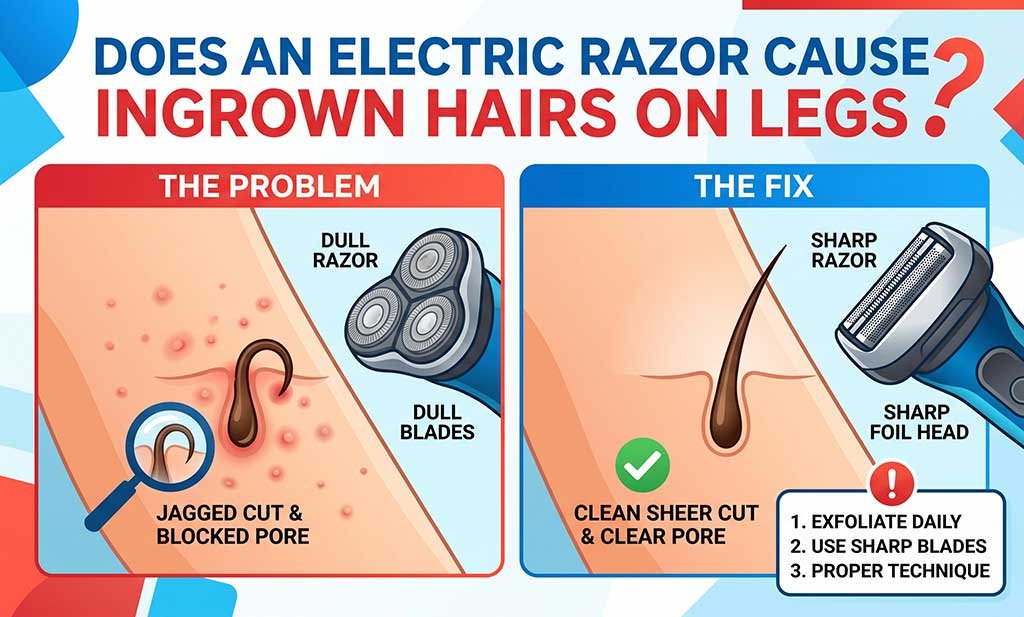
Table of Contents
Do Electric Shavers Cause Ingrown Leg Hairs?
Yes, an electric razor can cause ingrown hairs on your legs if your technique is flawed or your equipment is dull. However, they are significantly less likely to cause razor bumps compared to a traditional multi-blade cartridge razor.
When a foil shaver or rotary razor has damaged or dull blades, it stops cleanly cutting the hair. Instead, it “chews” the strand, leaving a jagged, uneven edge. This jagged edge can easily curl back around and re-enter the skin as it grows.
This phenomenon is medically known as pseudofolliculitis. Because the skin on your shins and calves is thin and under constant friction from clothing, these trapped hairs quickly turn into painful, inflamed bumps.
How Electric Razors Interact With Leg Skin Anatomy
To truly understand why skin irritation happens, you have to look at how different tools process your hair. Your leg skin anatomy is unique, and it requires a specific approach compared to shaving your face or underarms.
The “Chewing vs. Slicing” Mechanism
A traditional razor uses a sharp blade to slice cleanly through the hair shaft, ideally right at or slightly below the surface of the skin. This creates a sharp, angled tip.
An electric device works entirely differently. It uses a scissor-like action where a moving block of blades oscillates behind a perforated metal screen. The hair enters the holes in the screen, and the blades sheer it off.
When these internal blades get dull, they no longer sheer the hair smoothly. They violently tug and mash the hair, creating a frayed, blunt tip. This frayed tip struggles to push through the skin’s surface during the natural leg hair growth patterns, often getting trapped underneath.
Why Leg Hair is Uniquely Prone to Trapping
Your legs present a unique shaving challenge. The skin over your shins has almost no subcutaneous fat, meaning you are pressing hard metal directly against bone. This increases the risk of micro-abrasions and skin trauma.
Furthermore, the calves and thighs are constantly subjected to friction from tight jeans, leggings, or sweatpants. This friction presses growing hairs flat against the skin, encouraging them to grow sideways rather than straight out of the follicle.
Combined with dry skin—which is incredibly common on the lower extremities—dead skin cells act like a concrete barrier over the pores. Even a cleanly cut hair will struggle to penetrate this layer of dead skin, leading to inevitable bumps.
Does An Electric Razor Cause Ingrown Hairs On Legs When Used Incorrectly? (5 Reasons)
Even with the most expensive grooming tools on the market, poor technique will always lead to skin problems. If you are experiencing irritation, one of these five common mistakes is likely the culprit.
- 1. Pressing Too Hard Against the Skin:Many people mistakenly believe that pushing the shaver harder into the leg will result in a closer shave. In reality, pressing hard simply pushes the skin up into the foil holes. The internal blades then micro-slice your skin, causing massive inflammation and swelling that traps the hair.
- 2. Using Dull or Damaged Foil Screens:The metal screen on a foil shaver is incredibly delicate. Over time, it warps and the internal cutter block loses its edge. Using a dull shaver forces you to pass over the same patch of skin repeatedly, drastically increasing the chances of mechanical skin trauma.
- 3. Shaving Against the Grain on Sensitive Thighs:While the skin on your lower calves might tolerate shaving against the grain, the upper thighs are highly prone to pseudofolliculitis. Shaving upward against the natural downward growth pattern can force the hair under the skin line, virtually guaranteeing a trapped hair.
- 4. Skipping Pre-Shave Dry Exfoliation:Exfoliation is non-negotiable. If you run a shaver over legs covered in microscopic dead skin cells, those cells get pushed into the open pores. This creates a plug that blocks the hair from growing outward normally.
- 5. Moving the Shaver Too Fast:Speed is the enemy of a clean cut. If you drag the device rapidly up your leg, the hairs do not have time to properly enter the holes of the foil or rotary heads. Instead of being cut, the hairs are violently yanked and stretched, damaging the follicle root.
Electric Razor vs. Manual Razor: Which is Worse for Leg Ingrowns?
When trying to banish razor bumps forever, you have to choose the right weapon. Let’s compare how different types of razors stack up when it comes to skin health and hair trapping risks.
Feature | Foil Electric Shaver | Rotary Electric Razor | Multi-Blade Cartridge Razor |
Cutting Action | Oscillating blades behind a flat metal screen | Spinning circular blades behind floating disc heads | Direct blade-to-skin scraping and slicing |
Closeness of Cut | Very close, but leaves hair just at the skin level | Moderate, best for longer or contouring hair | Extremely close, often cuts below the skin line (Hysteresis) |
Skin Friction Level | Low to Medium (depending on pressure used) | Medium (circular motion can cause slight tugging) | Very High (removes top layer of epidermis) |
Ingrown Hair Risk | Low (Hair isn’t cut below the skin surface) | Moderate (Hair can be pulled in multiple directions) | Very High (Hair retracts beneath skin and gets trapped) |
Best Used For | Everyday maintenance on sensitive, flat skin areas | Navigating contours like knees and ankles | Achieving the absolute smoothest feel for a day |
As the table clearly shows, a traditional cartridge razor poses the highest risk. The “lift and cut” technology in manual razors pulls the hair up, cuts it, and lets it snap back beneath the skin. This almost guarantees problems for curly or coarse hair.
A high-quality foil shaver, on the other hand, glides over the skin without removing the top layer of the epidermis. Because the hair is sheared flush with the skin—rather than beneath it—the hair has a clear, unobstructed path to continue growing outward.
How to Prevent Ingrown Hairs on Legs When Using an Electric Shaver
Having the right tool is only half the battle. To achieve perfectly smooth, irritation-free skin, you must adopt a comprehensive routine. This three-step process will completely change your grooming game.
The Ultimate Pre-Shave Leg Prep Routine
Preparation dictates your results. Begin by dry brushing your legs before you ever step into the shower. A stiff-bristled brush swept in upward strokes will loosen dead, flaky skin and physically lift flat-lying hairs away from the skin surface.
Next, wash your legs with a cleanser containing salicylic acid. This beta-hydroxy acid dives deep into the pores, dissolving the oil and dead skin bonds that cause blockages. Make sure your legs are completely, 100% bone-dry before the device touches your skin. Moisture causes the shaver to drag and skip.
Correct Shaving Technique for Legs
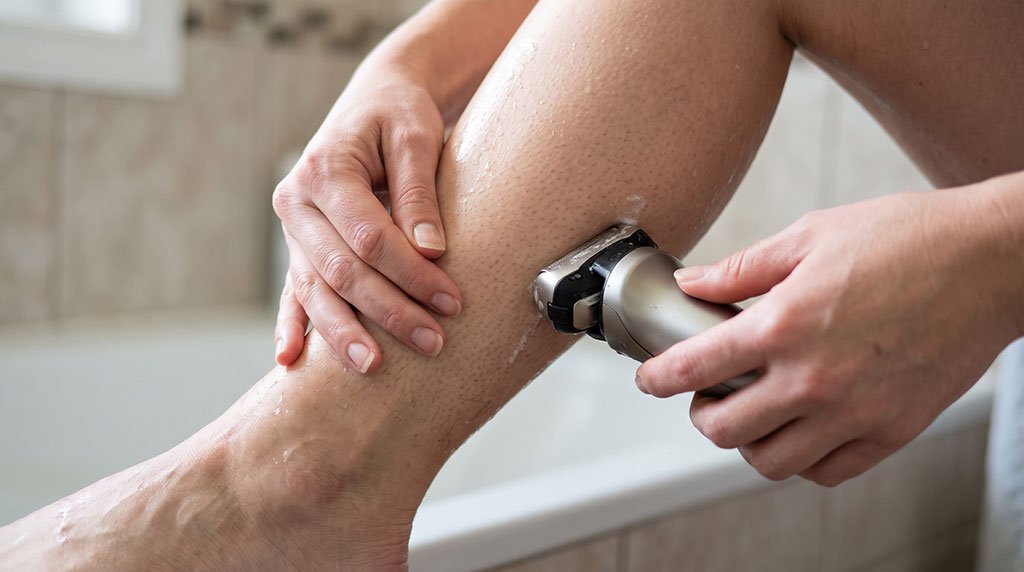
Always hold the shaver at a perfect 90-degree angle to your leg. This ensures the maximum amount of hair enters the cutting block efficiently. Use your free hand to pull the skin taut; flat, tight skin prevents the foil from catching loose folds and causing micro-cuts.
Use slow, deliberate strokes. Allow the motor to do the work rather than relying on your arm speed. If you are using a foil device, use straight up-and-down motions. If you are using a rotary device, use small, overlapping circular motions to catch hairs growing in different directions.
Post-Shave Care to Keep Follicles Clear
What you do immediately after grooming is critical. Avoid heavy, pore-clogging body butters immediately after shaving. Instead, apply a lightweight, alcohol-free witch hazel toner to instantly soothe inflammation and close the pores without burning the sensitive skin.
Follow this up with a chemical exfoliant lotion containing lactic or glycolic acid. This prevents dead skin from accumulating over the freshly cut hairs in the crucial 48 hours after your routine. Keeping the follicle exits clear is the absolute secret to bump-free legs.
When to Replace Your Electric Shaver Parts
Many users suffer in silence, believing their skin is just overly sensitive, when the real culprit is a decaying grooming tool. You cannot achieve a clean, healthy cut with compromised metal.
Most manufacturers strongly recommend replacing your foil screen and inner cutter block every 12 to 18 months. However, if you have coarse, thick leg hair, or if you shave large surface areas frequently, you may need to swap these parts out every 6 to 8 months.
Visually inspect your device every week. If you see tiny dents in the metal foil, or if it feels like it is pulling and tugging rather than gliding effortlessly, it is time to invest in a replacement head immediately. Do not risk your skin health to save a few dollars on parts.
FAQ
Yes, if your device is specifically rated as a “wet/dry” model. Shaving with a quality shaving oil in the shower can provide exceptional lubrication, reducing skin friction. However, dry shaving often provides a closer cut because the hairs stand up straighter when they are not weighed down by water.
Rotary devices typically cause slightly more irritation on the legs than foil options. The spinning motion of a rotary head can pull hairs in multiple directions, which occasionally damages the follicle root on sensitive skin. Foil devices operate in a straight, predictable line, making them gentler for those prone to pseudofolliculitis.
Your skin needs a transition period. It generally takes about three to four weeks for your skin to adapt to the new cutting mechanism. During this time, you might experience slight redness or miss a few hairs. Stick with it and do not alternate back to a manual blade, as this resets the adjustment clock.
Conclusion
Let’s wrap up everything we have covered today. So, does an electric razor cause ingrown hairs on legs? It absolutely can if you rush the process, press too hard, or neglect your pre-shave prep. However, when compared to the aggressive scraping of traditional blades, powered shavers remain the superior choice for sensitive skin.
The key to unlocking beautifully smooth legs lies in mastering your technique and respecting your skin’s anatomy. By committing to regular chemical exfoliation, using slow and deliberate strokes, and keeping your cutting blocks sharp, you can virtually eliminate those painful red bumps from your life.
Stop accepting skin irritation as a normal part of your grooming routine. Take action today: inspect your current shaver for dull blades, upgrade your pre-shave skincare, and give your legs the gentle treatment they deserve. Check your device’s manual right now to see if it is time to order replacement parts!


Leave a Reply