
You just spent good money on a top-tier grooming tool, yet you are still asking yourself, “Why does my electric shaver leave stubble?” The reality is that your electric shaver leaves stubble primarily because of the physical metal barrier that sits between the cutting blades and your skin.
Unlike a manual razor, electric shavers are engineered to cut hair just above the skin’s surface. However, excessive, patchy stubble is not normal. It is usually caused by dull blades, clogged cutting blocks, a low battery dropping motor RPM, or simply shaving facial hair that is too long for the machine to handle.
If you are tired of the five o’clock shadow appearing at noon, you are in the right place. We are going to dive deep into the mechanical science of your shaver and the anatomical quirks of your beard. Stop blaming the machine, and let’s fix your morning routine.
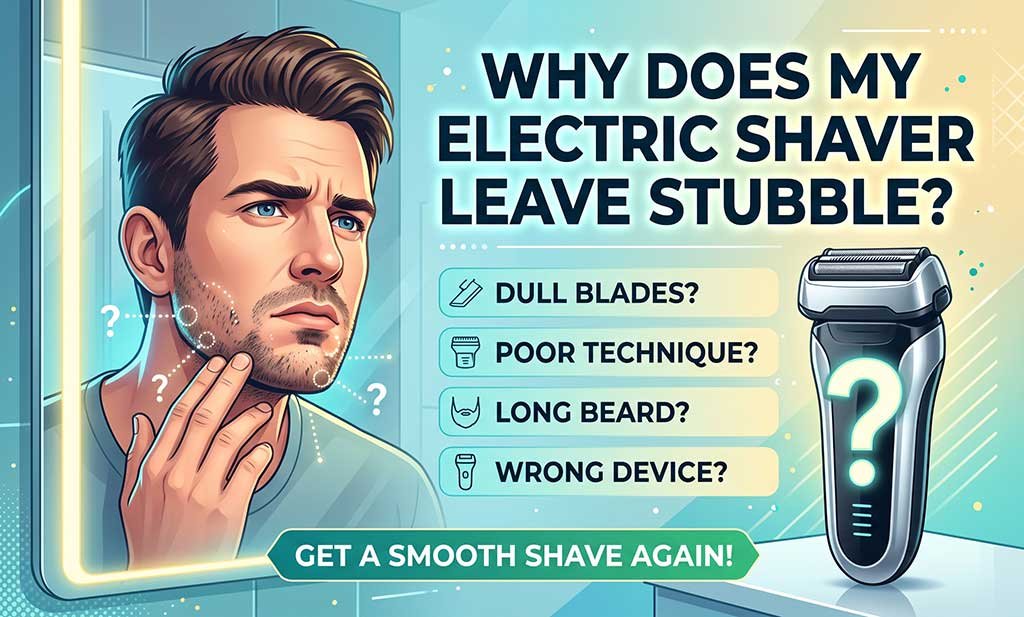
Table of Contents
Why an Absolute Smooth Shave is Difficult
Before we troubleshoot your specific device, we need to understand the fundamental physics at play. A lot of frustration comes from comparing two entirely different hair removal methods. Your manual cartridge razor and your electric machine do not operate on the same mechanical principles.
The Foil Barrier (The Micron Dilemma)
The most critical factor dictating the closeness of your shave is foil thickness. Whether you use a rotary or a foil shaver, there is always a piece of perforated metal separating the rapidly moving blades from your delicate skin. This metal screen must be strong enough not to buckle under pressure, yet thin enough to allow a close cut.
Engineers measure this thickness in microns. The sheer physical reality is that an electric shaver can only cut the hair down to the exact thickness of that metal screen. If the foil is 50 microns thick, your hair will be 50 microns long after the blade shears it off. It is physically impossible for the machine to cut closer than the thickness of its own guard.
How Electric Shavers Actually Cut Hair
Let’s talk about how manual razors trick you into feeling completely smooth. Cartridge razors utilize a phenomenon known as hysteresis. The first blade catches the hair and pulls it slightly out of the hair follicle. The next blade slices it off before it retracts. When the hair snaps back below the skin line, you feel absolute smoothness.
Electric shavers do not lift and pull in the same aggressive manner. Instead, they rely on a scissor-like chopping action. The facial hair enters through the holes of the foil, and the oscillating blades (or rotating cutters) shear the hair off flush with the foil surface.
Because there is no sub-dermal cutting, you will almost always feel a micro-texture if you rub your hand heavily against the grain. However, to the naked eye, the shave should look perfectly clean. If it looks visibly patchy, that indicates a performance failure. Let’s explore exactly why that happens.
7 Hidden Reasons Why Does My Electric Shaver Leave Stubble Behind
When your face is left looking like sandpaper, the problem usually stems from a breakdown in either your tool’s mechanics, your skin preparation, or your shaving technique. Let’s diagnose the seven most common culprits behind a poor electric shave.
1. Your Facial Hair is Too Long (The 3-Day Rule)
This is the number one mistake men make. Electric shavers are highly specialized tools designed for daily or every-other-day maintenance. They are engineered to feed short, rigid hairs through tiny microscopic perforations.
If you try to shave a four-day beard, those hairs are no longer rigid. They bend, flex, and curl over the foil instead of poking through the holes. When long hair refuses to enter the cutting chamber, the shaver just pushes it around, flattening it against your face. Or worse, the blade catches the tip and painfully yanks the hair. If your beard is over a millimeter long, you are setting yourself up for failure.
2. The Battery RPM is Dropping Under Load
A shaver is only as good as the motor driving it. Modern high-end shavers utilize a linear motor drive capable of delivering upwards of 10,000 to 70,000 cross-cutting actions per minute. This extreme speed is required to cleanly shear coarse hair without snagging.
However, as your battery drains, the voltage drops. Even a slight dip in power reduces the motor’s RPM (revolutions per minute). When the motor slows down, the blades lose their kinetic momentum. Instead of slicing cleanly, they begin to chew, pull, or skip over dense patches entirely. Keeping your device fully charged ensures maximum mechanical torque.
3. You’re Fighting the Grain Incorrectly
Manual shaving teaches us to go with the grain first to avoid irritation. If you apply this exact logic to a foil shaver, you will end up with terrible results. Because electric shavers do not pull hairs out of the follicle, they rely entirely on the hair standing straight up to enter the foil holes.
To achieve this, you must shave strictly against the grain direction. By moving the shaver head against the natural growth pattern, you force the hairs to stand upright, feeding them directly into the cutting blocks. If you move with the grain, you are simply ironing the hair flat against your skin.
4. The “Flat-Lying Hair” Dilemma on the Neck
The neck is the ultimate proving ground for any electric grooming tool. Unlike the chin and cheeks where hair grows straight out, neck hair often grows in swirling patterns and lies almost completely parallel to the skin. These are known as flat-lying hairs.
Entry-level shavers lack the specialized lifting elements required to pick up these stubborn hairs. The foil glides right over them, leaving distinct patches of long stubble on your lower neck. Fixing this requires strategic skin stretching and sometimes upgrading to a shaver with a dedicated middle trimmer designed specifically for flattened hairs.
5. Worn Foils and Clogged Cutting Blocks
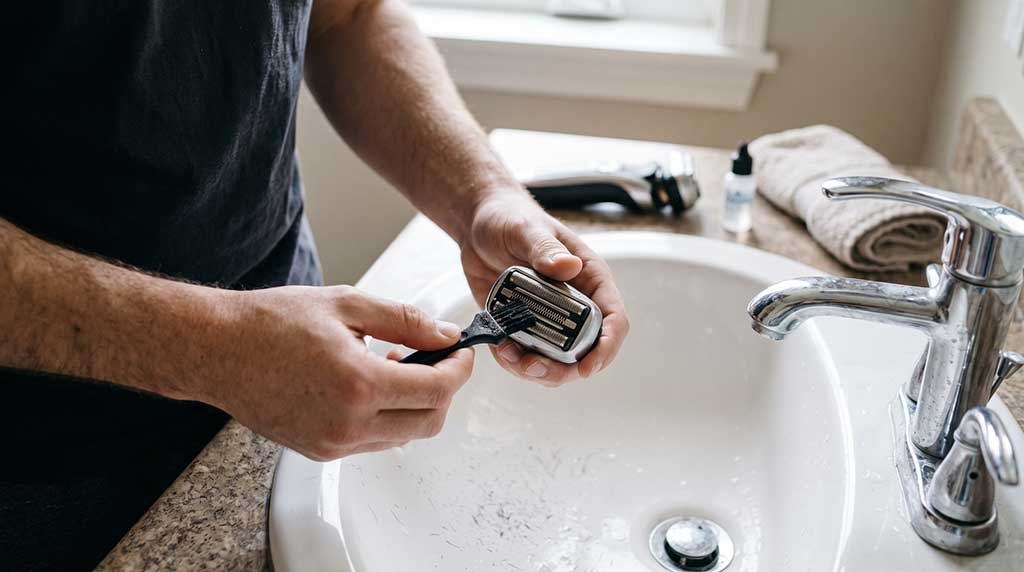
Your shaver is essentially a tiny lawnmower, and it requires pristine mechanics to work. Over time, a mixture of severed hairs, dead skin cells, and natural sebum (skin oils) builds up inside the head. This gunk acts as a physical barrier, clogging the foil holes and dulling the blades.
Furthermore, the metal foils themselves degrade. The microscopic edges of the perforations become warped, and the oscillating blades lose their razor-sharp edge. If you are pressing harder and harder to get a clean shave, your cutting head is likely exhausted. A dull blade pushes the hair away instead of cutting it.
6. Moisture is Ruining Your Dry Shave
If you are a dry shaver, moisture is your absolute worst enemy. Whether it is sweat from a morning workout, high humidity in the bathroom after a shower, or just natural skin oils, dampness causes the shaver head to drag and stutter across your face.
When the skin is damp, it becomes sticky. The hair clumps together, and the shaver head cannot glide smoothly. The friction causes the machine to bounce, entirely missing patches of hair. This is why utilizing a quality pre-shave powder or alcohol-based splash is crucial to absorb moisture and stiffen the hair.
7. A Tool and Beard Mismatch
Sometimes, the tool simply lacks the horsepower for your specific genetics. If you possess a dense, exceptionally coarse beard, a budget rotary shaver with a weak motor will struggle to process the sheer volume of hair.
A weak motor bogs down in thick density, leading to missed hairs and painful tugging. Men with wiry, thick facial hair require the high RPMs of a premium foil shaver equipped with advanced cutting blocks. If your device sounds like it is struggling when it hits your chin, you are underpowered.
How to Fix Electric Shaver Stubble (Step-by-Step Routine)
Now that we understand the mechanical failures and anatomical challenges, it is time to build a bulletproof routine. Achieving a flawless electric shave requires preparation, precision, and maintenance. Follow this sequence exactly.
Step 1: Trim First (The Golden Rule)
If your beard is longer than a two-day shadow, do not reach for the shaver yet. Grab your adjustable beard trimmer and knock the entire beard down to a 1mm length. By doing the heavy lifting with a trimmer, you ensure the shaver only has to handle the microscopic stubble it was designed for.
Step 2: Prep the Canvas (Wet vs. Dry)
You must commit to one style of shaving and prepare your skin accordingly.
- For Dry Shaving: Ensure your face is bone-dry. Wash your face with warm water and soap to remove sebum, then dry it completely with a towel. Apply a pre-shave powder or an electric pre-shave lotion. This stiffens the hair and provides a frictionless glide.
- For Wet Shaving: If your device supports wet/dry operation, use a very thin layer of slick shaving gel. Do not use thick foams, as they create an air pocket between the foil and the skin, preventing the hairs from entering the holes.
Step 3: Perfect the Angle and Stretch
Turn the shaver on and ensure the battery is fully charged for maximum RPM. Hold the shaver at a strict 90-degree angle to your face. You want the entire surface of the foil flush against your skin.
Now, use your free hand to pull your skin incredibly taut. This is the secret weapon for the neck. Pulling the skin tight achieves two things: it creates a flat surface for the shaver to glide over, and it forces flat-lying hairs to stand up straight. Move slowly against the grain. Do not rush. Let the machine do the work without aggressive pressure.
Step 4: The Maintenance Loop
Immediately after shaving, you must clean the device. If you have an automatic cleaning station, use it. It flushes out debris and lubricates the blades simultaneously.
If you clean manually, pop the head off, brush out the debris (never brush the delicate foils directly), and rinse it under hot water. Once a week, apply a single drop of clipper oil or mineral oil to the foils and run the machine for ten seconds. This reduces friction, prevents heat buildup, and keeps the blades cutting sharply. Finally, commit to replacing the entire cutting head assembly every 12 to 18 months.
Foil vs. Rotary Shavers: Which Leaves Less Stubble?
The eternal debate in men’s grooming always comes down to foil versus rotary technology. While both can provide a great shave when used correctly, their mechanical designs interact with stubble differently. Here is a breakdown of how they handle the challenges of facial hair.
Feature / Challenge | Foil Shavers | Rotary Shavers |
Blade Motion | Rapid oscillating blades behind a straight metal screen. | Circular spinning blades behind circular metal guards. |
Closeness Potential | Generally cuts slightly closer due to thinner foil screens and higher RPM motors. | Excellent, but the slightly thicker guards can leave microscopic length. |
Handling Flat-Lying Hairs | Struggles slightly without specialized center-trimming cassettes. | Excels at catching hairs growing in multiple directions, especially on the neck. |
Best Beard Type | Fine to medium hair, straight growth, sensitive skin. | Thick, coarse beard hair, multi-directional growth, tough skin. |
Ideal Technique | Straight, linear strokes strictly against the grain. | Circular, overlapping motions to catch swirling hair growth. |
If you are obsessed with absolute closeness on your cheeks and jawline, a high-end foil shaver is usually the superior choice. If you constantly battle swirling neck hairs that refuse to stand up, a rotary shaver’s circular motion might be the solution you need.
To see a fantastic visual breakdown of how premium shavers handle difficult stubble and how different models perform, check out this excellent comparison video:
Watching the mechanics in action will help you visualize the correct angle and pressure required for a flawless finish.
FAQ
Under a microscope, no. Due to the physical thickness of the metal foil, electric shavers cut slightly above the skin line, whereas manual razors cut slightly below it (using hysteresis). However, to the naked eye and a gentle touch, a high-end electric shaver can provide a look that is indistinguishable from a manual shave.
Absolutely not. Pressing hard is a terrible habit. It causes the skin to bulge into the foil perforations, leading to severe razor burn and irritation. It also wears down the metal foils rapidly. If you feel the need to press hard, your blades are dull, or your technique is wrong.
Most manufacturers recommend replacing the cutting blocks and foils every 12 to 18 months, assuming you shave daily. If you have a very thick, coarse beard, you may need to replace them closer to the 10-month mark to maintain peak performance and avoid stubble retention.
Conclusion
In short, expecting any machine to deliver the glass-like smoothness of a straight razor will always lead to mild disappointment due to the physical barrier of the foil screen. However, asking “Why does my electric shaver leave stubble” when your face looks visibly patchy is a completely solvable problem.
By keeping your facial hair short, maintaining your device’s mechanics, ensuring a high motor RPM, and strategically stretching your skin to catch flat-lying hairs, you can achieve a remarkably close, irritation-free shave every single morning. Stop blaming the hardware, refine your preparation, adjust your technique, and keep those blades well-oiled. Your perfect shave is just a few adjustments away.



Leave a Reply