
Frustrated by hair stuck at the exact same length? You might be wondering, does cutting dead ends help hair grow faster from the scalp? The short answer is no, but it is the ultimate secret to retaining length.
As a senior editor, I see this growth myth constantly. People avoid the salon, terrified of losing their hard-earned length.
But ignoring damaged ends is exactly what keeps your hair from reaching your lower back. Let’s dive deep into the true science of hair growth and length retention.
By the end of this highly scannable guide, you will know exactly how to manage your ends without sacrificing a single inch of your progress.

Table of Contents
How Your Hair Actually Grows
To understand your hair, we must look beneath the surface. Your hair is an incredible biological structure, but the part you actually see is no longer living.
Here is exactly how your hair functions from the inside out:
- The visible shaft is dead tissue: Your strands consist of a hardened protein complex. Strong keratin bonds give your hair its structure, strength, and elasticity.
- Active growth happens underneath: The real magic occurs completely out of sight, deep inside the hair follicle beneath your scalp.
- The dermal papilla feeds the root: Located at the base of the follicle, it connects to your blood supply, providing nutrients and oxygen for cellular division.
- Damage is permanent: Because the visible hair strand is not living, it cannot heal or repair itself once it is physically damaged.
- Natural oils fall short: Your scalp produces sebum, a natural oil. However, this moisture rarely reaches the ends of very long hair, causing severe dryness.
Three Phases of the Hair Growth Cycle
Your hair does not grow continuously. Every single follicle operates on its own individual timeline, consisting of three distinct phases:
- The Anagen Phase (Growth): The active growing period where cells divide rapidly. This lasts two to seven years, largely determined by your genetics.
- The Catagen Phase (Transition): A short transitional state where active growth completely stops. The follicle shrinks and detaches. This lasts two to three weeks.
- The Telogen Phase (Resting): The hair enters a resting state while new hair forms beneath it. Eventually, the old hair sheds naturally.
Why Dead Ends Stunt Your Progress
Many feel their hair simply stops growing at a certain point. Unless you have a medical condition, your hair is likely still growing at the root. The problem lies at the bottom.
What Are Split Ends (Trichoptilosis)?
To fix the problem, we need to correctly identify it. Here is what happens when a split end forms:
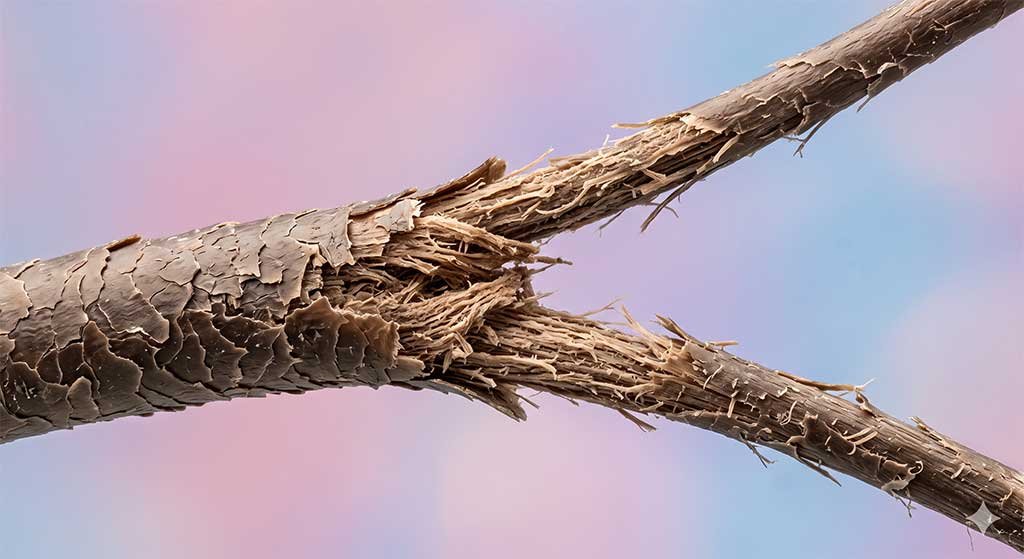
- The Cuticle Degrades: The protective outer layer of your hair, the hair cuticle, acts like overlapping shingles. Daily washing, heat, and chemicals chip these shingles away.
- The Cortex is Exposed: Once the cuticle is stripped, the highly vulnerable inner core, known as the cortex, is completely exposed to the elements.
- The Fraying Begins: Without the cuticle holding it tightly together, the core structure splinters and frays apart, creating a split end (Trichoptilosis).
The Traveling Split End Effect
A split end never stays at the very tip of your hair. If ignored, the damage progresses rapidly:
- It acts like a zipper: As you wash and brush, physical friction forces the split to peel higher up the hair shaft.
- Structural integrity drops: The higher the split travels, the weaker and thinner the hair strand becomes.
- Snapping occurs: Eventually, the strand becomes so dangerously fragile that it completely snaps off. This is known as mechanical damage.
Breakage Rate vs. Growth Rate
Your actual visible length is determined by a simple mathematical equation: Net Length = Growth Rate – Breakage Rate.
- The Growth: The average person grows about half an inch of new hair monthly from the scalp.
- The Breakage: If you hold onto severe damage, those brittle ends constantly break off in small, unnoticed pieces.
- The Result: If you grow half an inch, but half an inch breaks off, your net growth is zero. Trimming drops your breakage rate, letting you keep the length you produce.
Myth vs. Fact: Hair Trimming and Growth Rate
There is an overwhelming amount of conflicting information online. Let’s separate the old wives’ tales from biological science.
The Popular Claim | Myth or Fact? | The Scientific Truth |
Cutting ends stimulates the scalp to grow faster. | Myth | Trimming dead ends has absolutely no biological effect on the follicles safely hidden beneath the scalp. |
Split ends can be permanently repaired with products. | Myth | Conditioners temporarily seal the cuticle, but a sharp pair of scissors is the only permanent cure for a split. |
Regular trims actually lead to longer-looking hair. | Fact | Trimming actively stops progressive breakage, allowing you to keep the new length you organically grow. |
Does Cutting Dead Ends Help Hair Grow? The Science of Length Retention
Let’s address our core topic directly. Does cutting dead ends help hair grow from a purely biological standpoint? We know scissors cannot magically speed up production.
However, cutting dead ends absolutely helps your hair become longer over time.
- Growth vs. Retention: Growth is what your scalp does naturally. Length retention is how you actively protect that growth from snapping off.
- Creating a Seal: When you remove a damaged end, you create a clean, structurally sound blunt edge that is highly resistant to fraying.
- Stopping the Cycle: By consistently managing this damage, you stop taking one step forward with root growth and one step backward with end breakage.
How to Remove Dead Ends Without Losing Your Length
The thought of a salon chair causes anxiety for anyone trying to grow their hair out. Thankfully, you can manage damage without sacrificing your silhouette.
The “Micro-Trimming” Technique
If you are terrified of losing length, ask your stylist for a micro-trim.
- Tiny cuts: This technique involves taking off barely one-eighth to one-quarter of an inch.
- Targeted removal: It removes only the very tips of the severely frayed cuticle.
- Maintains density: Micro-trimming keeps your hemline thick and healthy without visibly changing your overall length.
The “Search and Destroy” (Dusting) Method
If you want to avoid cutting your hemline entirely, hair dusting is revolutionary. You can easily do this targeted approach at home:
- Prep the hair: Take small sections of completely dry, detangled hair.
- Twist tightly: Tightly twist the section from the root all the way down to the tip.
- Identify the damage: Healthy strands will stay smoothly in the twist. The broken, split ends will awkwardly pop out along the sides.
- Snip carefully: Use professional, razor-sharp shears to carefully snip off only the damaged pieces sticking out.
How Often Should You Really Cut Your Hair? (By Hair Type)
The standard advice of “trim every six weeks” is wildly outdated. Your ideal schedule depends entirely on your specific hair texture and hair porosity.
- Fine or Fragile Hair (Every 4-6 weeks): Fine strands have a weaker inner structure. They are highly susceptible to daily mechanical damage and require frequent, tiny micro-trims.
- Chemically Treated or Bleached Hair (Every 6-8 weeks): Bleach aggressively strips the hair cuticle, raising hair porosity. Regular trims prevent these compromised ends from splitting rapidly.
- Thick or Coarse Hair (Every 10-12 weeks): Coarse hair has a robust inner structure and a tightly packed cuticle. You can safely stretch the time between trims without risking massive breakage.
- Textured or Curly Hair (Every 12-16 weeks): The natural bends in curly hair make it difficult for sebum to travel down. This type benefits from specialized dry cutting every few months to maintain its distinct shape.
Proven Ways to Actually Stimulate Hair Growth at the Root
Cutting your ends only helps with length retention. To actually speed up the root, you must treat the scalp as the fertile soil where hair grows.
Scalp Health and Blood Flow
- Clear buildup: Ensure your scalp is free of heavy product buildup so the follicles can breathe and thrive.
- Massage daily: Take five minutes a day to firmly massage your scalp, manually stimulating localized blood flow to the dermal papilla.
- Use rosemary oil: Incorporating diluted rosemary essential oil has been shown to encourage a longer, healthier Anagen phase.
Internal Nutrition and Keratin Production
- Prioritize protein: Hair is non-essential tissue. A protein-rich diet is absolutely non-negotiable for producing strong, resilient strands.
- Stay hydrated: Ensure you are consuming adequate healthy fats and drinking enough water daily.
- Consider supplements wisely: Supplements like Biotin support cellular energy, but they can never replace a truly balanced diet.
Minimizing Mechanical and Heat Damage
- Upgrade your pillowcase: Swap rough cotton for smooth, friction-free satin or pure silk to prevent microscopic tearing while you sleep.
- Use thermal protection: Always apply a high-quality heat protectant spray before picking up a curling iron or a blow dryer.
- Detangle gently: Opt for wide-tooth combs over aggressive brushes, especially when your hair is wet and highly fragile.
Upgrading Your Complete Grooming Routine
Managing the hair on your head is only one part of your overall personal care routine. While your scalp requires gentle micro-trimming to retain length, managing body hair requires entirely different specialized tools.
If you are currently overhauling your at-home grooming habits, using the right hardware is just as important as your trimming schedule. For those looking to upgrade their body grooming kit, finding a tool that prevents razor bumps and irritation on sensitive skin is crucial.
We highly recommend checking out our comprehensive guide on the best women’s electric razor for pubic hair to complete your routine safely and effectively.
Bottom Line
Ultimately, achieving your dream hair length requires a highly dedicated, two-front strategy. You must diligently nurture your scalp environment to maximize active cellular growth.
Simultaneously, you must meticulously protect your delicate ends. A fresh haircut will never magically speed up your active follicles.
However, sacrificing a tiny quarter-inch of severe damage today is the absolute best way to ensure you gain two inches tomorrow.
So, does cutting dead ends help hair grow? It secures the exact growth you already have, stopping the silent thief of breakage in its tracks.
Do not let progressive split ends rob you of your daily progress. Grab sharp professional shears, schedule that tiny micro-trim, and start truly retaining your length today.



Leave a Reply