
Are you constantly battling skin irritation every morning? Knowing the exact difference between trimmer and razor is the first step to a painless morning. If you are tired of nicks, cuts, and aggressive redness, you are not alone in this daily struggle.
Choosing the right tool transforms how your face feels all day. It is not just about cutting hair to look presentable. It is about protecting your delicate skin barrier from severe daily damage. Let’s break down exactly how these tools work.
Getting familiar with your grooming equipment saves you time and money. We will look beyond the basic marketing claims of shaving brands. You will learn the exact mechanical actions, long-term costs, and optimal use cases for both types of tools.
Table of Contents
How Razors and Trimmers Actually Cut Hair
To make a smart choice, look directly at the physics of facial hair removal. Manual blades and electric motors have completely different mechanics. This physical gap dictates everything from your skin reaction to the required daily maintenance.

The Build of a Razor
A manual razor uses a concept called hysteresis, or the “lift and cut” method. The first blade pulls the hair slightly out of the follicle. Subsequent blades slice through the hair before it naturally retracts back into your skin.
This pulling action gives you that incredibly smooth, glass-like finish. You will not feel any stubble when rubbing your skin against the grain. But this aggressive mechanism comes with a heavy price for your long-term skin health.
Every single pass of a multi-blade razor scrapes away your top layer of skin. You are essentially performing daily micro-dermabrasion on your face. This direct, harsh contact causes severe post-shave stinging and massive moisture loss.
The Build of a Trimmer
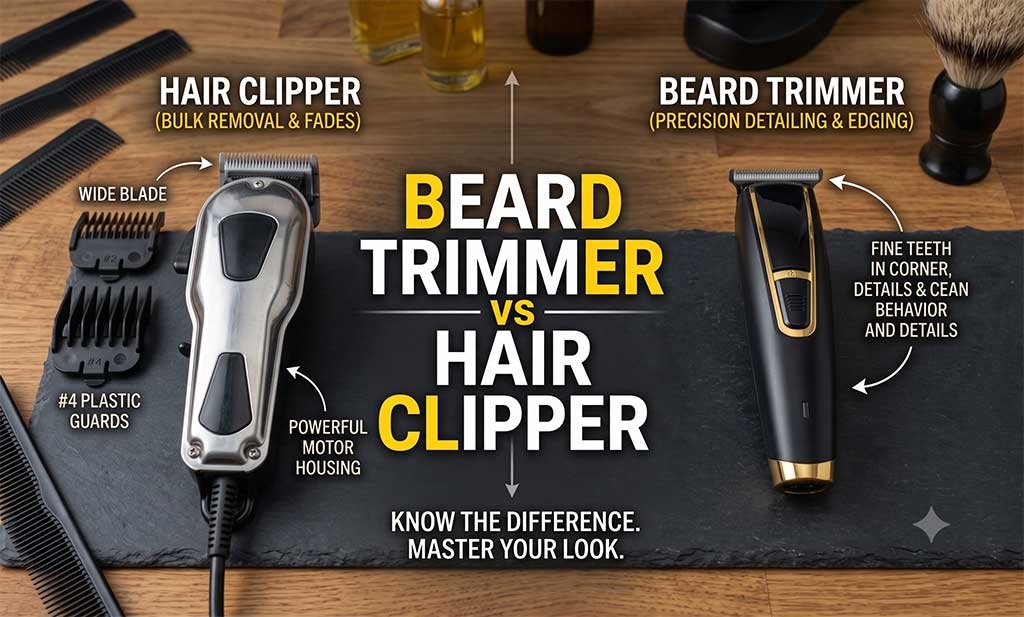
Electric trimmers operate on a shearing principle, functioning like microscopic scissors. They feature a stationary guard comb and a rapidly moving cutting blade. Hair enters the stationary comb slots and gets snipped instantly by the moving teeth.
Because the guard comb rests against your face, the moving blades never touch your skin. This is the biggest factor separating electric tools from manual blades. A physical metal barrier prevents the direct scraping that causes severe irritation.
This means you never get a totally smooth, friction-free finish. Even without a plastic guard, the metal teeth leave a tiny fraction of hair behind. This slight stubble physically protects your skin surface from unnecessary daily damage.
Difference Between Trimmer and Razor: Comparison
When settling the trimmer vs shaver debate, a side-by-side analysis clears things up quickly. Different tools excel in entirely different environments. Here is a clear, scannable breakdown of how they compare across the most critical grooming categories.
Feature | Manual Razor | Electric Trimmer |
Finish | Completely smooth (skin-level) | Stubble to long beard (guard dependent) |
Skin Contact | High (removes top skin cells) | Zero to Minimal (blades do not scrape) |
Prep Required | High (water, heat, shave cream) | Low (can be instantly used dry) |
Maintenance | Frequent blade cartridge changes | Occasional oiling, long blade life |
Speed | Slower (requires careful strokes) | Extremely fast (quick passes) |
Travel Friendly | Requires foam and water access | Highly portable, usable anywhere |
If your job demands a strict, clean-shaven look, a manual blade remains standard. It provides the closest possible result for a long workday. But you must allocate extra time for hot water prep and proper lathering.
An electric tool offers unmatched convenience for busy mornings. You can quickly shape a beard or maintain a shadow in under three minutes. The lack of prep makes it the absolute ultimate travel companion for modern professionals.
Which Tool Wins for Sensitive Skin and Razor Bumps?
The battle against skin irritation makes your choice of tool extremely critical. If you suffer from constant redness, your current routine is hurting your face. The dermatological impact of daily blade contact is huge and widely ignored.
[Image placement: nano banana, photorealistic split screen showing healthy facial skin on one side and inflamed skin with razor bumps on the other, clinical lighting, high detail, 8k]
When a manual blade scrapes your skin’s outer barrier, it causes microscopic tears. Your body responds with instant inflammation, causing redness and burning. This compromised barrier lets bacteria in, leading to mild acne and infections.
For guys with curly or coarse hair, the “lift and cut” method is terrible. Hair cut beneath the skin line often curls back as it grows. This trapped hair causes pseudofolliculitis barbae, medically known as severe razor bumps.
Switching to an electric tool is the best razor bumps prevention strategy available. Oscillating blades cut hair above the skin, so follicles never retract underneath. Hair grows straight out, completely eliminating ingrown hairs and painful neck bumps.
A solid grooming routine for sensitive skin entirely abandons multi-blade manual tools. If you absolutely need a close finish, try a single-blade safety razor. Otherwise, an electric tool is the definitive, painless cure for most guys.
The 5-Year Cost Breakdown: Cartridges vs. Electric Trimmers
Grooming companies rely on the “razor and blades” model for continuous revenue. They sell cheap handles and make massive, recurring profits on replacement cartridges. Over five years, this recurring expense becomes a major financial drain.
Let’s look directly at the math for a standard multi-blade routine. A quality handle costs around $15. If you change a $3 cartridge weekly, you spend $156 annually. Over five years, that is nearly $800 spent just on blades.
This cost excludes the necessary shaving creams, gels, and soothing aftershaves. You pay a premium just to manage the irritation the blades cause. It is an endless cycle of buying expensive products to fix tool-created problems.
Compare this to buying a premium lithium-ion electric trimmer. A professional-grade, high-torque device costs about $80 upfront. A $10 bottle of clipper oil easily lasts the entire five-year lifespan of the tool.
Your total five-year cost for the electric route is well under $100. Also, the environmental impact is drastically lower. You stop throwing away non-recyclable plastic cartridges and pressurized metal cans into local landfills.
Can You Use a Trimmer to Shave Your Head or Body?
Many men want to consolidate their entire grooming routine into one device. You can do this, but you must know the limits of a standard facial tool. Different body areas need specific blade designs for safety.
If you are evaluating a zero trim vs clean shave for your head, trimmers are excellent. A balding clipper leaves your scalp cleanly buzzed without cuts. Manual blades on the scalp often cause severe irritation and unexpected bleeding.
But using a standard facial tool for below-the-neck manscaping is risky. Facial blades have wider gaps to catch thick beard hairs. These wider gaps will easily pinch the loose, sensitive skin on your chest and groin.
For safe body grooming, grab a dedicated body groomer with a specialized foil. These tools glide smoothly over loose skin without biting or pulling. Keep your facial tools strictly above the neckline to avoid painful accidents.
The “Hybrid” Grooming Routine: How to Use Both Tools Together
The best approach to facial hair management does not force you to pick just one tool. Professional barbers use a hybrid routine for sharp, skin-friendly looks. You can easily replicate this high-end technique at home right now.
- Step 1: Bulk Removal: Never take a manual blade directly to a thick beard. Use your electric tool with a guard to trim the hair short. This stops your manual blade from instantly clogging and painfully pulling hairs.
- Step 2: Edge Definition: Remove the plastic guard from your electric tool. Use the bare metal teeth to stamp crisp, hard lines on your cheeks. The precise T-blade allows for perfect facial symmetry and sharp angles.
- Step 3: The Clean Finish: Apply a slick, clear shaving gel exclusively to your neck. Take a fresh manual blade and gently clear away the neck stubble. This creates a sharp, professional contrast with your neat facial beard.
This hybrid method successfully gives you the best of both worlds. You get the rugged, structured look of a beard with a polished, smooth neck. Most importantly, you limit harsh blade contact strictly to less sensitive skin areas.
FAQ
No, this is a very common optical illusion. A manual blade cuts the hair at a flat angle, leaving a blunt tip. This blunt tip feels coarser and looks darker than a naturally tapered hair end. The biological reality that cutting dead protein cannot speed up follicle activity is also why many wonder if cutting dead ends helps hair grow faster on your scalp—the rule remains identical across all human hair.
A zero trim means using an electric clipper without any plastic guard attached. It relies purely on the bare metal blades to cut hair incredibly close. It leaves a micro-stubble that looks clean but completely prevents ingrown hairs.
Yes, foil and rotary electric shavers are explicitly built to replace manual blades. They use a thin metal screen to capture and cut hairs close. They provide a near-smooth finish without the aggressive scraping of a manual blade.
Conclusion
When deciding on the exact difference between trimmer and razor, there is no universal winner. You only have the right tool for your specific skin type. If you demand a flawless, glass-smooth finish, the manual blade wins every time.
Just make sure you invest time in proper lather and quality aftercare. But if you battle sensitive skin or prefer stubble, change your routine immediately. A high-quality electric tool is your absolute best investment for daily comfort.
For the modern man, the smartest approach isn’t choosing just one tool. It is mastering the hybrid routine to get a sharp, irritation-free look. Get the right gear, protect your skin barrier, and upgrade your morning.



Leave a Reply